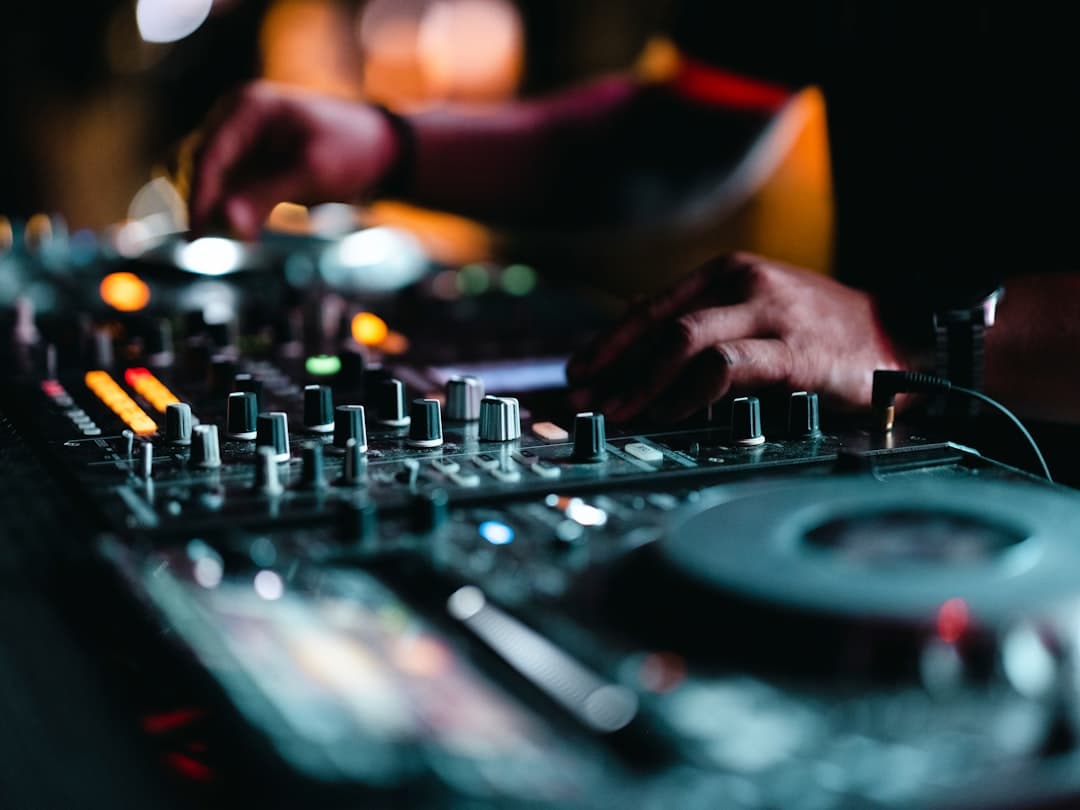
A corporate event DJ is a professional who manages the full audio environment of a business event, including music, microphone coordination, and program flow from start to finish. Unlike a club or wedding DJ, a corporate DJ functions as an event production partner, not just a music source. They coordinate with planners, AV teams, and speakers to keep every transition clean and every moment on schedule. For corporate event planners, understanding this role is the first step toward booking the right professional and protecting the guest experience.
What is a corporate event DJ and what do they actually do?
A corporate event DJ manages the entire audio environment, including music and microphone transitions across the run-of-show to create smooth event flow. That definition matters because it separates a true corporate DJ from a generalist who simply plays songs. The role covers everything from cueing intro music for each program segment to managing wireless microphone handoffs during presentations and Q&A sessions. Every transition the audience never notices is a transition the DJ executed correctly.
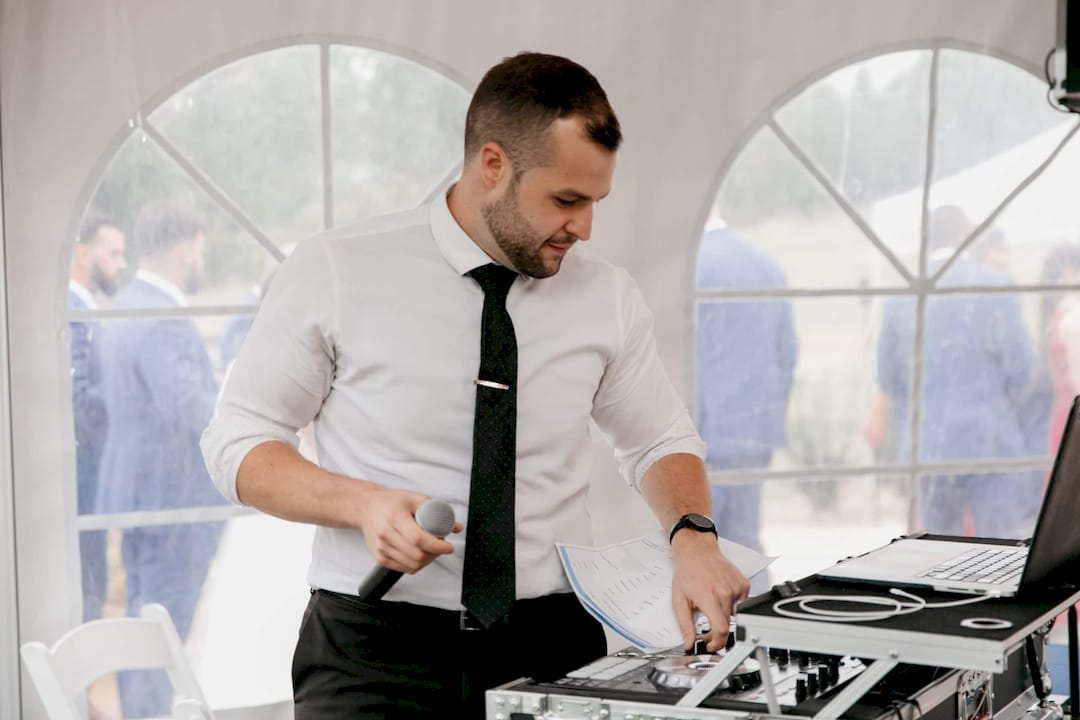
The industry term for this professional is “corporate event DJ,” though some production companies also use the title “event entertainment specialist” or “event production DJ” when the role includes full AV coordination. Both terms describe the same core function: a skilled technician who protects the audio integrity and pacing of a business event.
Corporate DJs also provide emcee services to deliver announcements and host the program, which reduces the need for multiple vendors. That combination of DJ and MC in one professional is one of the clearest advantages of hiring a specialist over a generalist.
What are the primary responsibilities and skills of a corporate event DJ?
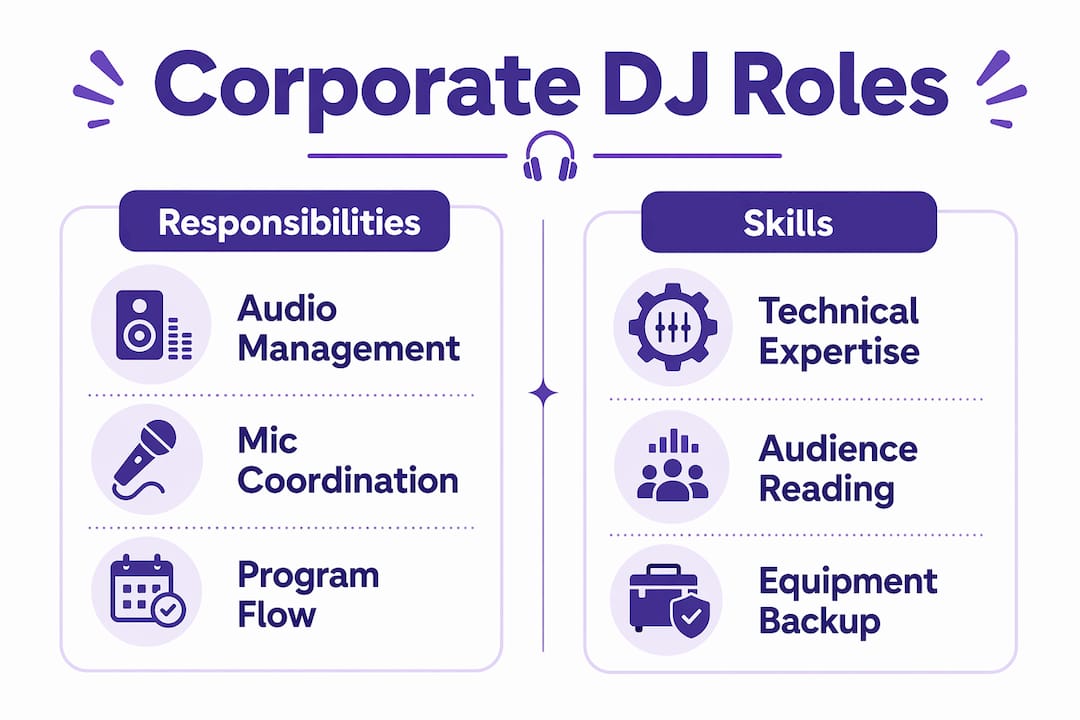
The scope of a corporate DJ’s work is wider than most planners expect. The role combines music curation, live audio engineering, microphone management, and real-time audience reading into a single position.
Core responsibilities include:
-
Music and audio management: Setting appropriate volume levels for arrival, cocktail hour, dinner, and any dance segment, adjusting in real time as the room fills or empties.
-
Microphone handling: Microphone handoffs from handheld to lavalier to headset are the most common failure points in a corporate event. A prepared DJ routes each mic type cleanly and has contingencies ready before the first speaker walks on stage.
-
Run-of-show alignment: Following the event timeline precisely, including speaker cues, award presentations, and networking breaks, so every segment starts and ends on time.
-
Audience energy management: Reading the room and adjusting music tempo and style to match the energy of each phase, from focused conference sessions to celebratory award dinners.
-
Emcee duties: Hosting announcements, introducing speakers, and keeping the program moving when no dedicated MC is on the team.
-
Equipment setup and AV coordination: Arriving early, installing gear, and coordinating with in-house AV teams to confirm signal routing and backup systems.
Pro Tip: Ask any DJ candidate to walk you through how they handle a microphone failure mid-presentation. Their answer reveals whether they have real corporate experience or are guessing.
Corporate DJs require expertise in professional microphone management to avoid feedback and dead air during presentations. That technical standard is what separates a qualified corporate DJ from a general entertainment DJ who happens to own a wireless mic.
How does a corporate event DJ differ from other types of DJs?
The differences between a corporate DJ and a wedding or club DJ are significant enough to affect event outcomes. The table below shows the key distinctions.
| Factor | Corporate event DJ | Wedding or club DJ |
|---|---|---|
| Primary focus | Program flow and audio production | Dance floor energy and crowd entertainment |
| Microphone work | Handheld, lavalier, and headset management | Typically handheld announcements only |
| Run-of-show role | Follows detailed event timeline with speaker cues | Follows loose set list or playlist |
| Emcee capability | Frequently required | Optional or limited |
| Coordination partners | Planners, AV teams, speakers, venue ops | Couple, venue coordinator |
| Event types served | Conferences, award galas, product launches, company parties | Receptions, nightclubs, private parties |
| Professional demeanor | Business-appropriate attire and language at all times | Varies by event style |
A corporate DJ working a product launch for a technology company, for example, must coordinate video playback cues, manage a panel discussion microphone rotation, and transition into a networking reception, all within the same booking. A club DJ has no training for that sequence. The corporate DJ functions as an event production partner who protects against operational disruptions during speaker walk-ons, awards, and Q&A sessions.
Contract and liability focus also separates corporate DJs from generalists. Business events carry higher financial and reputational stakes, and professional corporate DJs treat insurance, written contracts, and backup equipment as standard operating procedure, not optional extras.
What should corporate event planners know about hiring a corporate DJ?
Hiring a corporate DJ requires more due diligence than booking entertainment for a private party. The following steps protect your event and your organization.
-
Verify corporate experience. Ask for a list of corporate clients and event types. A DJ with a portfolio of conferences, galas, and product launches is a fundamentally different hire than one whose experience is weddings and school dances.
-
Check references. Call at least two corporate event planners who have worked with the DJ. Ask specifically about microphone handling, run-of-show adherence, and professional conduct.
-
Require liability insurance and a COI. Liability insurance and a Certificate of Insurance (COI) naming the venue are not optional. Venues often block load-in without these documents on file. Request the COI at least two weeks before the event.
-
Use a detailed written contract. Written contracts are critical in corporate DJ hiring and must specify dates, times, services, equipment, cancellation policies, overtime rates, and backup provisions. A handshake agreement creates financial and reputational risk.
-
Conduct pre-event planning calls. Corporate DJ services include pre-event planning such as questionnaires, run-of-show reviews, and coordination calls. Any DJ who skips this step is not prepared for a corporate environment.
-
Confirm backup equipment. Ask what happens if the primary system fails. A professional corporate DJ carries redundant gear and has a documented contingency plan.
Pro Tip: Book your corporate DJ at least 60–90 days before the event. The best corporate DJ professionals fill their calendars early, and last-minute bookings often mean settling for less experienced vendors.
Liability insurance, backup equipment, and a well-defined contract are operational safeguards, not optional extras. Treat any vendor who pushes back on these requirements as a red flag.
What does a professional corporate DJ service typically include?
A professional corporate DJ service covers far more than showing up with speakers and a laptop. The full scope runs from pre-event planning through post-event breakdown.
Standard inclusions from a qualified corporate DJ service:
-
Early arrival and soundcheck: A corporate event DJ typically arrives 90–120 minutes before event start to set up equipment and complete a full soundcheck. That window is non-negotiable for technical readiness.
-
Full equipment installation: Professional-grade speakers, subwoofers, mixers, and a full wireless microphone system with multiple mic types. Backup gear should be on-site and ready to deploy.
-
Event arc coverage: Music programming across every phase, including guest arrival, cocktail hour, dinner service, award presentations, and any dance segment. Each phase has a distinct audio identity.
-
Microphone management throughout: Coordinating mic distribution, monitoring battery levels, and executing clean handoffs between speakers, panelists, and award recipients.
-
Emcee and host duties: Introducing segments, reading award citations, and keeping the program on schedule when the event does not have a dedicated host.
-
Coordination with venue AV teams: Integrating with in-house systems for video playback, presentation support, and room-wide audio coverage.
-
Virtual and hybrid event support: Many corporate DJ professionals now offer audio management for hybrid formats, including clean audio feeds for remote attendees and live stream integration.
Corporate event DJ responsibilities often combine simultaneous roles including music curator, microphone technician, emcee, and flow manager. That combination requires clear contract scope so every responsibility is documented and agreed upon before the event date.
Key Takeaways
A corporate event DJ is a specialized event production professional whose value lies in audio management, microphone expertise, and program flow, not playlist selection alone.
| Point | Details |
|---|---|
| Core role definition | A corporate DJ manages audio, microphones, and program flow across the full event timeline. |
| Microphone expertise is critical | Clean mic handoffs between speakers are the most common failure point in corporate events. |
| Contracts and insurance are required | Written contracts and a COI naming the venue are non-negotiable for professional corporate bookings. |
| Pre-event planning is standard | Questionnaires, run-of-show reviews, and coordination calls are part of any qualified corporate DJ service. |
| Early arrival is expected | Professional corporate DJs arrive 90–120 minutes early for setup and soundcheck. |
What I’ve learned from working corporate events that most articles won’t tell you
The biggest mistake planners make is treating the DJ as the last vendor to book and the first to cut when the budget gets tight. That logic gets the priority exactly backward. The DJ controls the audio environment for the entire event. A weak hire does not just affect the dance floor. It affects every speaker introduction, every award moment, and every transition the audience experiences.
Corporate DJs are valued more for their ability to read and adapt to business audiences and manage event tempo than for playlist taste alone. That insight took me a while to fully appreciate. A DJ who reads the room at a corporate gala and drops the energy at exactly the right moment during an executive speech is worth far more than one with a great music library and no situational awareness.
The other thing planners consistently underestimate is the emcee function. When a DJ can host the program cleanly, you eliminate a coordination layer. You get one professional who knows the run-of-show, controls the audio, and can pivot in real time if a speaker runs long or a segment gets cut. That flexibility is what separates a good corporate event from a great one.
Check the contract and the COI before you confirm any booking. Not after. Venues have turned away vendors on load-in day over missing insurance documents, and no planner wants to solve that problem at 7 a.m. on event day.
— Drew
Fiestafusion’s corporate event DJ services in Northern Utah
Fiestafusion is a veteran-owned entertainment company serving corporate event planners across Northern Utah with professional DJ services built for business events.
From conferences and award galas to company parties, Fiestafusion brings professional-grade audio, wireless microphone management, and run-of-show coordination to every booking. The team works directly with planners on pre-event questionnaires and timeline reviews so nothing is left to chance on event day. Fiestafusion also offers 360 photo booth rentals and event enhancements that add interactive guest experiences alongside DJ entertainment. Visit Fiestafusion to review service options and request availability for your next corporate event.
FAQ
What is a corporate event DJ?
A corporate event DJ is a professional who manages music, microphone coordination, and program flow for business events such as conferences, award galas, and product launches. The role goes beyond playing music to include emcee duties, AV coordination, and run-of-show execution.
How is a corporate DJ different from a wedding DJ?
A corporate DJ focuses on program flow, microphone management, and business-appropriate audio production, while a wedding DJ focuses primarily on dance floor energy and crowd entertainment. Corporate events require stricter run-of-show adherence and more complex microphone handling.
What should a corporate DJ contract include?
A corporate DJ contract must specify the event date, start and end times, services provided, equipment list, overtime rates, cancellation policy, and backup provisions. Written contracts reduce financial and reputational risk for both the planner and the vendor.
Does a corporate event DJ need liability insurance?
A corporate event DJ must carry liability insurance and provide a Certificate of Insurance (COI) naming the venue as additionally insured. Many venues will block vendor load-in without this documentation on file before the event.
How far in advance should you book a corporate DJ?
Booking a corporate DJ at least 60–90 days before the event is the standard recommendation. Qualified corporate DJ professionals fill their schedules early, and late bookings limit your options to less experienced vendors.