
Pick one universal aggregator or full-service platform as your primary registry, then add a specialty retailer or a cash/experience fund on top of it. That combination gives guests a single canonical list to shop, keeps your gift options wide open across physical items, experiences, and cash, and stays easy for you to manage. Before you build anything, take a quick inventory of what you already own and set a target of 1.5 to 2 registry items per invited guest.
- Choose your primary platform first (universal or full-service)
- Do a home inventory to avoid duplicate gifts
- Add one specialty store or cash fund to round things out
- Set your item target based on your guest count
Key Takeaways
The strongest 2026 registry strategy pairs one universal or full-service platform with a specialty retailer or cash fund, sized at 1.5 to 2 items per guest and replenished every 48 hours after a purchase.
| Point | Details |
|---|---|
| Pick a primary platform | Choose a universal aggregator or full-service platform as your main list before adding anything else. |
| Size it with math | Target 1.5 to 2 items per invited household, not per individual guest. |
| Distribute price tiers | Aim for roughly a third under $50, a third $50 to $100, and smaller shares above $100. |
| Replenish fast | Replace purchased items within 48 hours so late shoppers still see real options. |
| Add an experience fund | List entertainment upgrades like a Fiesta Fusion photo booth or DJ package through a cash fund. |
Table of Contents
- What's the Best Wedding Registry for 2026?
- How Many Items Should Your Registry Have?
- How Do Registry Platform Fees Compare?
- What Payment and Fulfillment Options Do Registries Offer?
- What Are the Return and Refund Policies for Wedding Registries?
- How Good Is Customer Support Across Registry Platforms?
- Are Wedding Registries Safe to Use?
- What 2026 Couples Get Wrong About Registries
- Add an Experience Gift to Your Registry
- Sources
- FAQ
What's the Best Wedding Registry for 2026?
The honest answer depends less on brand names and more on which of five registry types fits how you actually want to receive gifts. Each type solves a different problem, and most couples end up combining two or three rather than relying on just one.
A universal aggregator like Zola or MyRegistry lets you pull products from almost any retailer, including Amazon, Etsy, Target, Crate & Barrel, or Pottery Barn, into one shareable list. MyRegistry's 2026 trend analysis calls this kind of universal setup the best fit for modern couples who want physical items, experiences, and cash funds under one roof, and it's the reason the format has overtaken single-store registries in popularity.
A full-service platform such as Zola or The Knot Registry goes a step further, bundling registry management with wedding websites, RSVP tracking, and vendor tools. If you want one login for everything related to the wedding, this is worth the tradeoff over a pure aggregator.
Retailer store registries (Target, Bloomingdale's, Crate & Barrel, Sur La Table, Belk) still matter because guests trust names they recognize, shipping tends to be fast, and most run completion discounts on unpurchased items after the wedding.
Specialty retailers like Anthropologie or Sur La Table shine for couples who want curated design pieces or serious cookware rather than generic bundles.
Cash and experience funds, through Honeyfund, Traveler's Joy, or GoFundMe, cover honeymoons, down payments, or big experiences gift cards can't touch.

Pro Tip: Don't register only where you'd shop for yourselves. Guests want variety in price and place just as much as you want good gifts.
How Many Items Should Your Registry Have?
Start with the math, not a guess. Registry experts recommend 1.5 to 2 items per invited guest, so a wedding inviting 100 guests should list a proportional number of items based on guest count and households. Skip this formula and you risk the two most common failures: a registry so thin that late RSVPs find nothing left, or one so bloated with random items that nobody can tell what you actually need.
- Calculate your target. Multiply invited households (not individual guests) by 1.5 to 2.
- Distribute by price tier. For a 100-item list, aim for roughly 30 to 35% under $50, 30 to 35% between $50 and $100, 20 to 25% between $100 and $250, 8 to 12% between $250 and $500, and 5 to 8% above $500, with cash funds making up another 10 to 15% of your overall list.
- Check platform features before committing. Look for unlimited item counts, the ability to pull products from any store, cash funds without processing fees, real-time purchase tracking, and a built-in checklist that flags gaps in your price tiers.
- Match platform type to your priority. Favor a universal aggregator if flexibility matters most, a full-service platform if you want wedding planning tools bundled in, and a retailer plus specialty combo if your guests skew traditional.
Zola's own survey data shows kitchen and cookware items appear on 78% of registries, making them the single most reliable category to stock heavily in your mid-price tier.
How Do Registry Platform Fees Compare?
Fees are where registries quietly differ the most, and most couples never check until money is already sitting untouched. Universal aggregators like MyRegistry and Zola typically let you add unlimited items from outside stores at no cost, but cash fund withdrawals sometimes carry a small processing fee, usually a percentage of each contribution plus a flat charge, similar to standard payment processing rates.
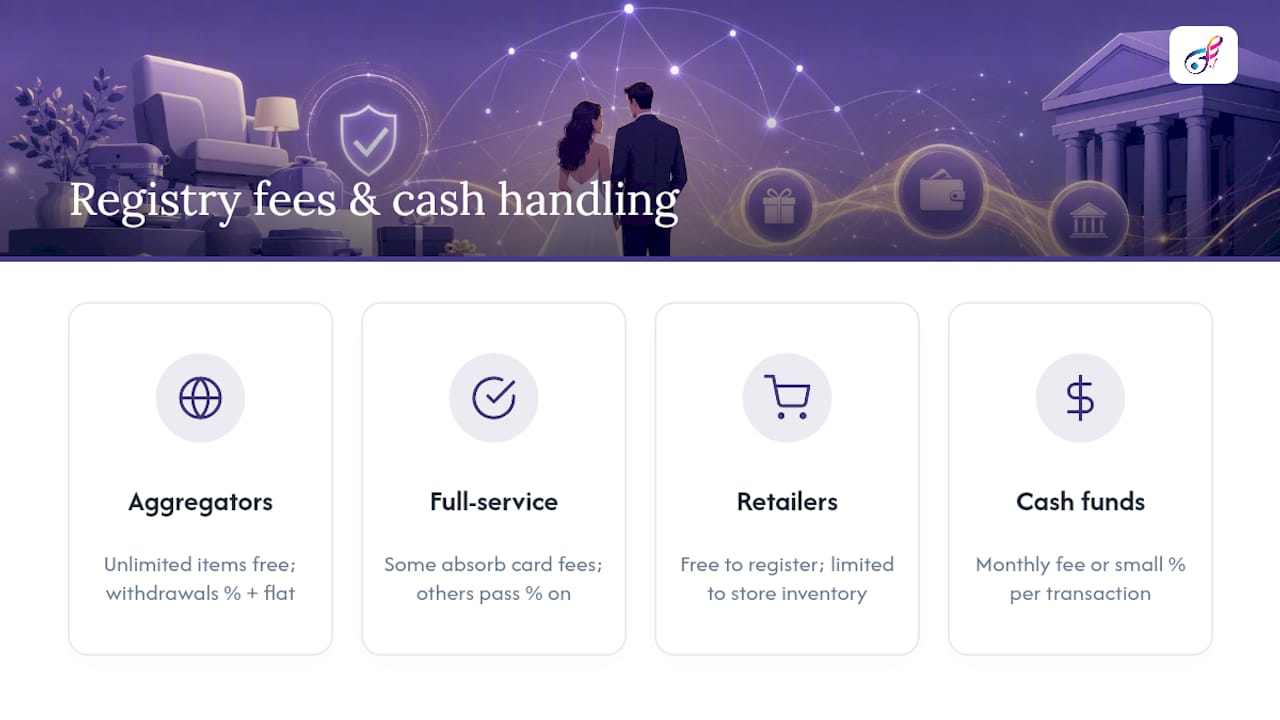
Full-service platforms bundle these costs differently. Some absorb card processing fees into the platform's revenue model and advertise "no fee" cash funds, while others pass a percentage straight through to contributors or to you at withdrawal. Retailer registries (Target, Bloomingdale's, Crate & Barrel) rarely charge anything to register, since they profit from the purchases themselves rather than the list, but they typically limit you to their own inventory.
Cash and experience fund platforms like Honeyfund and Traveler's Joy usually charge either a flat monthly fee for an ad-free experience or take a small percentage per transaction if you use the free tier. GoFundMe, built for general fundraising rather than weddings specifically, takes a standard processing cut on every donation.
Before choosing, read the fine print on three things: whether cash withdrawals are instant or take days, whether there's a minimum before you can transfer funds, and whether the completion discount (often around 10 to 20% 20% off unpurchased items) applies to cash funds or only to physical goods. Those details matter more than the sticker price of "free" registration.
What Payment and Fulfillment Options Do Registries Offer?
Guest-side payment flexibility varies more than most couples expect. Universal aggregators and full-service platforms typically accept major credit cards, debit cards, and sometimes digital wallets like PayPal or Apple Pay for both physical gifts and cash contributions. Retailer registries generally mirror that store's normal checkout, meaning Target and Bloomingdale's accept the same payment methods as their regular online stores.
Fulfillment splits into two models. When a guest buys a physical item directly through a retailer's registry, it ships from that retailer's own warehouse, often within the store's standard delivery window. When a guest buys through a universal aggregator that's pulling from multiple stores, the aggregator either redirects the purchase to complete on the retailer's site or processes it and forwards the order, which can add a day or two to shipping compared to buying direct.
Group gifting is worth checking too. Several platforms allow multiple guests to contribute toward one big-ticket item, splitting a $600 stand mixer six ways instead of one guest covering it alone. Cash funds settle differently still. Most transfer to your linked bank account on a schedule (some daily, some weekly), and a few, particularly on GoFundMe, require you to manually initiate the withdrawal rather than auto-depositing funds.
Mobile checkout is no longer optional. If a platform's mobile experience is clunky, guests scanning your registry from their phone at a shower will bounce, so test the checkout flow yourself before sharing the link widely.
What Are the Return and Refund Policies for Wedding Registries?
Return policies follow whichever retailer actually fulfilled the gift, not the aggregator that hosted your list. If a guest buys a blender through Target's registry, Target's standard return window and conditions apply, typically 90 days with a receipt or gift receipt. Buy the same blender through a universal aggregator that redirected the purchase to Target, and the same Target return policy still governs it.
This matters because couples sometimes assume the aggregator handles returns directly. It rarely does. Zola, MyRegistry, and similar platforms act as the list and checkout layer, but the actual retailer processes exchanges, refunds, and damaged-item claims. Crate & Barrel, Pottery Barn, and Bloomingdale's each publish their own return windows and restocking rules, so check the specific retailer's policy rather than assuming uniformity across your list.
Cash funds work differently again, and irreversibly. Once a guest contributes to a Honeyfund, Traveler's Joy, or GoFundMe fund, that money is essentially final. There's no "return" mechanism the way there is for a physical gift, which is one more reason to be upfront in your registry description about exactly what the fund is for.
One practical safeguard: keep gift receipts or registry purchase confirmations organized in one folder, digital or physical, for at least six months after the wedding. Thank-you notes go out faster when you're not hunting for proof of purchase to process an exchange.
How Good Is Customer Support Across Registry Platforms?
Support quality is uneven, and it's rarely mentioned until something goes wrong. Full-service platforms like Zola and The Knot Registry tend to offer the strongest support infrastructure, including live chat, email, and phone lines staffed specifically for wedding-related questions, since customer service is part of what justifies their all-in-one pricing.
Universal aggregators like MyRegistry generally provide email and chat support but route product-specific issues (a damaged item, a wrong shipment) back to the originating retailer, which can mean two separate support conversations instead of one. Retailer registries inherit whatever support tier that store already runs. Target and Bloomingdale's, for instance, apply their standard customer service channels to registry purchases, meaning wait times and quality mirror the retailer's general reputation rather than any wedding-specific team.
Specialty retailers like Anthropologie and Sur La Table tend to offer more personalized help simply because their catalogs are smaller and staff can speak knowledgeably about specific products. Cash fund platforms vary widely. Honeyfund and Traveler's Joy typically offer email support with modest response times, while GoFundMe, built for broader fundraising use cases, handles a much higher volume of unrelated requests, which can slow down wedding-specific questions.
Before relying heavily on any platform, search for its current support hours and channels directly, since staffing levels shift seasonally and wedding season (spring through early fall) tends to stretch response times across the board.
Are Wedding Registries Safe to Use?
Registries ask for a real mailing address, guest contact details, and often banking information for cash funds, which makes privacy worth a real look before you commit. Reputable platforms like Zola, MyRegistry, and The Knot Registry use standard encryption for payment processing and allow you to control whether your registry is publicly searchable or shareable only through a private link.
Check three settings before you publish anything: whether your address is visible to every guest or only revealed at checkout, whether your registry shows up in the platform's public search, and whether cash fund withdrawals require two-factor authentication. Most established platforms enable at least the first two by default, but it's worth confirming rather than assuming.
Guest-side security matters just as much. Anyone contributing to a cash fund is trusting the platform with card or bank details, so sticking to well-known names like Honeyfund, Traveler's Joy, or the major retailers reduces the risk of a guest hesitating to contribute. Avoid registry tools that ask guests to create unnecessary accounts or share more data than a purchase requires. If a platform feels unclear about how it handles contributor information, that's reason enough to look elsewhere.
What 2026 Couples Get Wrong About Registries
Most registry advice treats item count as the whole problem. It isn't. The couples who end up happiest aren't the ones who hit 200 items on the nose, they're the ones who built in enough price variety that a $25 gift and a $400 gift both feel like real options, and who actually replenished the list when things sold out.
That's the piece conventional wisdom skips. Replacing purchased items within 48 hours keeps a registry usable for the guest shopping three weeks before the wedding, not just the one who bought early. A registry frozen at "done" in April is often thin and picked-over by August.
The other overrated idea is spreading gifts across five platforms to maximize selection. Two to three complementary registries, one universal or full-service plus one specialty or cash fund, covers nearly everyone without forcing guests to hunt across tabs. If you take one thing from this guide, let it be this: set your item math early, distribute your price tiers on purpose, and treat replenishment as an ongoing task rather than a box you check once in the spring.
Add an Experience Gift to Your Registry
Not every meaningful gift arrives in a box. Cash and experience funds through Honeyfund or Traveler's Joy make it simple for guests to chip in toward something you'll actually remember, and a DJ or photo booth package is exactly that kind of gift. Fiesta Fusion's entertainment packages can be listed as a line item on an experience fund or split among a group of guests the same way a big-ticket kitchen item gets crowdfunded.
A 360 photo booth turns reception guests into content creators for the night, and it's the kind of upgrade couples often cut from the budget only to regret it later. Booking it through a registry fund instead of your own wedding budget means guests directly fund the part of the night people talk about for years. If you're planning a wedding in Northern Utah and want to see what packages look like before adding one to your fund, visit Fiesta Fusion to check availability for your date.
Sources
- 2026 Wedding Registry Trends Report — MyRegistry
- Wedding registry size guide — WithJoy
- Wedding registry checklist — Zola
- The Knot universal registry guidance — The Knot
FAQ
What Is the Best Wedding Registry Platform for 2026?
There's no single winner for every couple, but a universal aggregator or full-service platform paired with one specialty retailer or cash fund covers the widest range of guest preferences and gift types.
How Many Registry Items Do We Actually Need?
Multiply your invited household count by 1.5 to 2. For 100 invited households, that means listing 150 to 200 items across a range of price points.
Can We Register for a Honeymoon or Experiences Instead of Gifts?
Yes, and it's increasingly common. Zola's survey data shows 87% of couples now include or plan to include a cash fund alongside traditional physical gifts.
Can We List a DJ or Photo Booth as a Registry Gift?
Yes. Entertainment packages, including Fiesta Fusion's photo booth and DJ services, can be funded through a cash or experience fund and split among multiple guests.
How Often Should We Update Our Registry?
Replace purchased items within 48 hours of each sale to keep your list balanced across price tiers for guests shopping closer to the wedding date.