The top types of wedding music genres couples should plan around are pop, R&B/soul, hip-hop, EDM/dance, Latin (salsa, bachata, reggaeton), jazz/lounge, classical, country, indie/alternative, Motown/oldies, and acoustic/folk. Each one belongs at a different point in your day, and the smartest approach is to layer them by moment rather than pick one style and stick with it all night.
Here is how that layering works in practice:
- Ceremony: Classical, acoustic/folk, or indie/alternative for processionals and recessionals
- Cocktail hour: Jazz/lounge, acoustic, or Motown for a warm, social atmosphere
- Dinner: Soft R&B, acoustic, or instrumental pop to keep conversation easy
- First and parent dances: Romantic pop, R&B/soul, or country ballads
- Dance party: Pop, hip-hop, EDM, Latin, and Motown throwbacks to fill the floor
- Send-off: A high-energy anthem or a crowd-favorite singalong
Key Takeaways
The most effective wedding music strategy layers genres by moment, plans concrete song counts for each part of the day, and gives your DJ a specific brief that includes both must-play and do-not-play lists.
| Point | Details |
|---|---|
| Layer genres by moment | Use classical or acoustic for the ceremony, jazz for cocktail hour, and pop/R&B/hip-hop for the dance floor. |
| Plan song counts in advance | A full wedding day needs 8–12 musical moments; cocktail hour alone calls for 12–16 tracks. |
| Brief your DJ specifically | Provide a must-play list, a do-not-play list, preferred eras, transition cues, and a guest request policy. |
| Include all guest demographics | Build in at least one recognizable block for each major age or cultural group at your reception. |
| Fiesta Fusion for Northern Utah couples | Fiesta Fusion's wedding DJ services cover custom playlists, song edits, and full-night music management across Weber County, Davis County, and Salt Lake City. |
Table of Contents
- What each wedding music genre sounds like and when to use it
- Which genres work at each wedding moment
- How to build a wedding playlist that actually works
- Live band vs DJ vs hybrid: which option fits your wedding?
- Sample playlists by vibe
- Cultural and regional music traditions that belong at weddings
- How guest demographics shape your genre choices
- An honest take on what actually matters with wedding music
- Fiesta Fusion makes wedding music planning easier
- Sources
- FAQ
What each wedding music genre sounds like and when to use it
The genres that reliably keep guests dancing at receptions include pop, R&B/soul, hip-hop, EDM/dance, and Latin styles, but the full picture of popular wedding music styles covers a much wider range. Here is a genre-by-genre breakdown with placement guidance.
Pop
Bright, melodic, and universally familiar. Pop works at almost every moment because it crosses generations without alienating anyone. Use current chart hits for the dance floor and slower pop ballads for the first dance. Artists like Ed Sheeran, Taylor Swift, and Bruno Mars appear on nearly every wedding playlist for good reason.
Do: Mix current hits with early 2000s throwbacks for broader age appeal. Don't: Play the same era of pop all night or the energy will plateau.
R&B and soul
Warm, groove-heavy, and deeply romantic. R&B and soul are the go-to for first dances, parent dances, and the early dance-floor warm-up. Artists like Beyoncé, John Legend, and Alicia Keys carry emotional weight that pop sometimes lacks. Slower soul tracks (think Etta James, Sam Cooke) also work beautifully during dinner.
Hip-hop
High energy and crowd-tested. Hip-hop belongs in the peak dance-floor hours, typically after 9 PM when the floor is already warm. Clean edits are standard practice at weddings; brief your DJ explicitly about which tracks need radio versions. Artists like Jay-Z, Kendrick Lamar, and Drake alongside throwback acts like Outkast and Missy Elliott give you range across age groups.
EDM and dance
Pulse-driven and physically irresistible. EDM works best in short bursts during peak dance sets rather than as a sustained genre block. A well-placed drop from a track like "Levels" by Avicii or a Calvin Harris remix can spike energy at exactly the right moment. Keep it to 3–4 tracks per set unless your crowd skews younger.
Latin (salsa, bachata, reggaeton)
Latin styles add a distinct flavor and tend to pull reluctant dancers onto the floor. Bachata is the most accessible for couples who do not know Latin dance steps; reggaeton drives pure energy. Artists like Bad Bunny, Marc Anthony, and Shakira cover the full spectrum from romantic to party-ready. A Latin block of 4–5 songs mid-reception is a reliable crowd moment.
Jazz and lounge
Sophisticated and conversational. Jazz is the natural choice for cocktail hour and dinner because it fills space without demanding attention. A live jazz trio or a curated playlist of standards (Miles Davis, Norah Jones, Frank Sinatra) sets a polished tone that formal and semi-formal venues reward. Avoid uptempo bebop during dinner; stick to cool jazz and bossa nova.
Classical
Timeless and ceremony-specific. Classical music is the default for formal processionals and preludes, and for good reason: it carries weight without lyrics that might compete with the moment. Pachelbel's Canon in D, Handel's "Arrival of the Queen of Sheba," and Debussy's "Clair de Lune" are perennial choices. A string quartet or pianist elevates the ceremony; a recorded arrangement works just as well for most venues.
Country
Storytelling-driven and emotionally direct. Country works across multiple moments: slower ballads (Chris Stapleton, Kacey Musgraves) for first dances, mid-tempo tracks (Luke Bryan, Zac Brown Band) for the dance floor. If your guest list skews Southern or Midwestern, a country block mid-reception will land hard. Avoid heavy honky-tonk unless your crowd specifically loves it.
Indie and alternative
Textured, personal, and often unexpected. Indie and alternative choices signal that a couple has thought carefully about their music rather than defaulting to the obvious. Artists like Bon Iver, Sufjan Stevens, and Iron and Wine work for ceremony and cocktail hour. Upbeat indie (Vampire Weekend, Foster the People) can anchor a fun, non-traditional dance set.
Motown and oldies
Cross-generational and almost universally loved. Motown is one of the safest choices for a mixed-age dance floor because grandparents and twenty-somethings both know the words. "Ain't No Mountain High Enough," "September" by Earth, Wind and Fire, and "Dancing in the Street" are proven floor-fillers. Use Motown as a bridge between dinner and the main dance set.
Acoustic and folk
Intimate and unhurried. Acoustic and folk are ideal for the prelude, ceremony, and cocktail hour. A solo guitarist or a curated acoustic playlist creates warmth without volume. Artists like James Taylor, Fleetwood Mac (acoustic tracks), and The Lumineers give you a range from classic to contemporary. Avoid acoustic during peak dance hours unless you are transitioning down for a slow song.
Genre-to-moment quick reference:
| Genre | Best moments | Sample song |
|---|---|---|
| Pop | Dance floor, first dance | "Perfect" — Ed Sheeran |
| R&B/Soul | First dance, parent dances, dinner | "At Last" — Etta James |
| Hip-hop | Peak dance sets | "Crazy in Love" — Beyoncé |
| EDM/Dance | Peak dance sets | "Levels" — Avicii |
| Latin | Mid-reception dance block | "Vivir Mi Vida" — Marc Anthony |
| Jazz/Lounge | Cocktail hour, dinner | "Fly Me to the Moon" — Frank Sinatra |
| Classical | Prelude, processional, unity | "Canon in D" — Pachelbel |
| Country | First dance, mid-reception | "Tennessee Whiskey" — Chris Stapleton |
| Indie/Alternative | Ceremony, cocktail hour | "Skinny Love" — Bon Iver |
| Motown/Oldies | Dinner-to-dance transition | "September" — Earth, Wind and Fire |
| Acoustic/Folk | Prelude, cocktail hour | "Fire and Rain" — James Taylor |
Pro Tip: For ceremony music genres, choose a processional song with a tempo between 60 and 80 BPM. Play it for your wedding party during rehearsal and walk at a natural pace to confirm the timing before the actual day.
Which genres work at each wedding moment
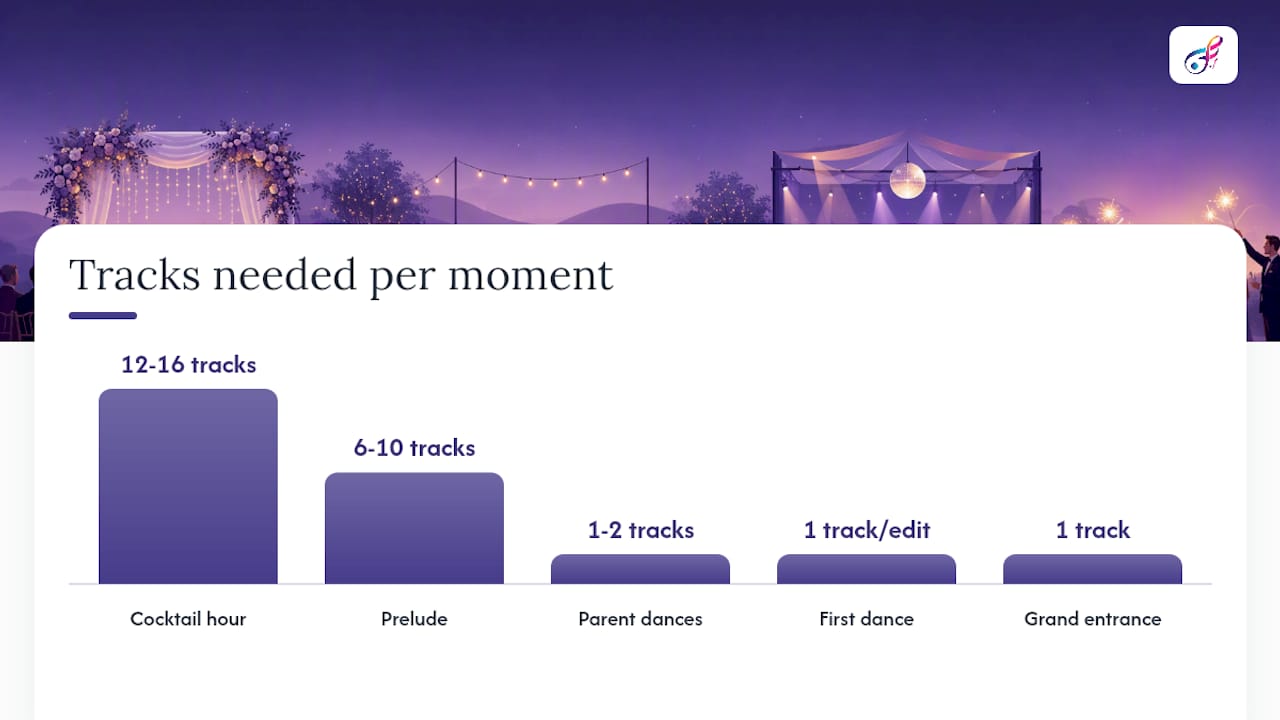
A complete wedding day typically needs 8 to 12 distinct musical moments, each with its own mood and track count. The table below maps each moment to recommended genres and practical song counts.
| Moment | Recommended genres | Track count | Mood/tempo guidance |
|---|---|---|---|
| Prelude | Classical, acoustic, jazz | 6–10 tracks | Soft and welcoming; guests are arriving and finding seats |
| Processional (wedding party) | Classical, acoustic, instrumental pop | 1 track | Stately, 60–80 BPM; time it to the aisle length |
| Processional (couple) | Classical, acoustic, romantic pop | 1 track | Emotional peak; often the most personal song choice |
| Unity ceremony | Instrumental acoustic or classical | 1 track | Background only; should not compete with the ritual |
| Recessional | Upbeat classical, pop, indie | 1 track | Celebratory; couples often choose something joyful here |
| Cocktail hour | Jazz, acoustic, Motown, lounge | 12–16 tracks | Ambient and social; guests are mingling and relaxed |
| Grand entrance | Pop, hip-hop, upbeat R&B | 1 track | High energy; the couple's personality in one song |
| First dance | R&B/soul, pop ballad, country | 1 full track or 2–3 min edit | Intimate; consider editing to 2.5 minutes if full song is long |
| Parent dances | R&B/soul, pop, country | 1–2 tracks | Tender; can be combined into one medley to save time |
| Cake cutting | Pop, jazz, fun novelty | 1 track | Light and celebratory |
| Dance sets | Pop, hip-hop, EDM, Latin, Motown | 45–60 min blocks | Build energy gradually; peak at 9–10 PM |
| Final send-off | Anthemic pop, crowd singalong | 1 track | End on a high note everyone knows |
Structuring the reception in three segments — cocktail hour, dinner service, and dance party — makes genre planning much cleaner. Each segment has a distinct energy target, and crossing them without a transition plan is where jarring genre switches happen.
Volume management note: Ceremony and cocktail hour music should sit at a conversational level, roughly 65–70 dB, so guests can talk without shouting. Dinner rises slightly. The dance floor can push to 85–90 dB during peak sets, but your venue's sound ordinance may cap it lower. Confirm the limit with your venue coordinator before the event.
Pro Tip: Tell your DJ the exact moment you want the music to shift, not just the song. "Start the cocktail hour playlist the moment the ceremony ends and the doors open" is clearer than "play cocktail music after the ceremony."
How to build a wedding playlist that actually works
Think of your wedding music as two things at once: mood architecture and practical logistics. The mood side is about genre and feel; the logistics side is about counts, cues, and briefing your vendor clearly.
Song counts per moment
Use these as your planning baseline, drawn from complete ceremony and reception guidance:
- Prelude: 6–10 tracks
- Processionals: 1 track each
- Unity and recessional: 1 track each
- Cocktail hour: 12–16 tracks
- Dinner: 10–14 tracks
- Grand entrance, first dance, parent dances, cake cutting: 1 track each
- Dance sets: 45–60 minute blocks (roughly 12–15 tracks per block at 3–4 minutes per song)
- Final send-off: 1 track
DJ and band briefing checklist
A short, specific vendor brief with a must-play and do-not-play list reduces on-the-night misunderstandings significantly. Hand your DJ or bandleader this checklist at least two weeks before the wedding:
- Must-play list: 10–15 songs you absolutely want played, with the moment each belongs to (first dance, dance floor, etc.)
- Do-not-play list: Songs, artists, or genres you want avoided entirely, no exceptions
- Preferred eras and genres: Name the decades and styles you love (e.g., "90s R&B, early 2000s pop, no heavy metal")
- Transition instructions: Where you want energy to build, where you want it to drop (e.g., "go quiet after the last parent dance before the grand entrance")
- Timing and cues: Exact moments for key songs, including who signals the DJ (you, your coordinator, or the MC)
- Guest request policy: Whether the DJ should take requests, filter them, or ignore them
- Song edits: Any tracks you want shortened or faded early, and the target length
Sequencing dos and don'ts
Do start the dance floor with broadly familiar tracks before moving into niche genres. Do use a slower song every 4–5 tracks to let guests catch their breath. Don't let the DJ go more than 20 minutes without reading the room and adjusting.
Guest requests are a real variable. A good approach: tell your DJ to accept requests but filter them against your do-not-play list and the current energy of the room. A request for a slow country ballad at 10 PM when the floor is packed is a momentum killer; a skilled DJ will hold it for later or skip it gracefully.
Live band vs DJ vs hybrid: which option fits your wedding?
That flexibility is the core argument for a DJ. But live music has its own case, and the right answer depends on your priorities.
DJ: Lower cost, unlimited song library, seamless transitions, and the ability to pivot genres mid-set without a break. A DJ can cover every moment from prelude to send-off with one setup. The tradeoff is that recorded music lacks the visual energy of live performance. For understanding what a professional wedding DJ actually does and how to brief one effectively, the role goes well beyond pressing play.
Live band: Visually exciting, energetically contagious, and memorable in a way recordings rarely match. The tradeoffs are real: bands cost more, need stage space and sound checks, have a limited setlist, and require breaks (usually covered by recorded music). A live band shines during the reception's peak hours but rarely makes sense for a 6-hour event solo.
Hybrid: A string quartet or jazz trio for the ceremony and cocktail hour, then a DJ for the reception. This is the most popular premium approach because it uses live music where intimacy matters most and recorded music where flexibility matters most. Budget permitting, it is hard to beat.
Quick scenario guide:
- Formal ceremony, 150+ guests, big dance floor: DJ or hybrid
- Intimate backyard wedding, 40 guests: acoustic guitarist or small jazz ensemble
- Multicultural reception with genre-switching needs: DJ (live bands rarely cover 4 genres in one set)
- Couple wants a specific song not in a band's setlist: DJ, always
Sound logistics: Live bands need 30–60 minutes for sound check and a stage area of at least 12 by 16 feet for a 4-piece group. DJs need 30 minutes for setup and a 6 by 8 foot footprint. Confirm both with your venue before booking.
Sample playlists by vibe
These are ready-to-use starting points. Mix and match across the night; the goal is a natural energy arc, not genre purity.
Classic romantic (ceremony and first dance)
- "Canon in D" — Pachelbel (prelude/processional)
- "A Thousand Years" — Christina Perri (processional)
- "At Last" — Etta James (first dance)
- "Can't Help Falling in Love" — Elvis Presley (parent dance)
- "The Way You Look Tonight" — Frank Sinatra (cocktail)
- "Unforgettable" — Nat King Cole (cocktail)
Modern pop (grand entrance and early dance floor)
- "Marry You" — Bruno Mars (grand entrance)
- "Love Story (Taylor's Version)" — Taylor Swift (early dance)
- "Thinking Out Loud" — Ed Sheeran (slow dance)
- "Uptown Funk" — Mark Ronson ft. Bruno Mars (dance floor)
- "Happy" — Pharrell Williams (dance floor)
- "Shake It Off" — Taylor Swift (dance floor)
Latin fusion (mid-reception dance block)
- "Vivir Mi Vida" — Marc Anthony (opener)
- "Bailando" — Enrique Iglesias (bachata-friendly)
- "Despacito" — Luis Fonsi ft. Daddy Yankee (peak energy)
- "La Bamba" — Ritchie Valens (crowd singalong)
- "Conga" — Gloria Estefan (floor-filler)
Mellow cocktail (jazz and acoustic)
- "Fly Me to the Moon" — Frank Sinatra
- "Come Away with Me" — Norah Jones
- "The Girl from Ipanema" — Astrud Gilberto
- "Better Together" — Jack Johnson
- "Ho Hey" — The Lumineers
- "Banana Pancakes" — Jack Johnson
High-energy late night (peak dance sets)
- "September" — Earth, Wind and Fire (Motown bridge)
- "Crazy in Love" — Beyoncé (R&B peak)
- "Yeah!" — Usher (hip-hop)
- "Don't Stop Believin'" — Journey (singalong)
- "Mr. Brightside" — The Killers (indie anthem)
- "Levels" — Avicii (EDM spike)
- "I Gotta Feeling" — Black Eyed Peas (send-off)
Pro Tip: If a song runs longer than 4 minutes and you want it played during a timed moment (cake cutting, bouquet toss), ask your DJ for a 2.5-minute edit that hits the chorus quickly and fades cleanly. Most professional DJs can prepare custom edits in advance.
Blending these playlists across the night works best when you plan the energy arc deliberately. Successful wedding playlists layer by energy and era: cocktail hour leans older and sophisticated, early reception mixes midtempo hits, peak hours use current chart hits and throwbacks, then a late-night throwback block closes the floor.
Cultural and regional music traditions that belong at weddings
The full taxonomy of music genres includes dozens of regional and cultural styles that translate beautifully to wedding settings. Three of the most requested in the U.S. are Celtic, Bollywood, and Klezmer, but the list goes much further.
Celtic: Irish and Scottish folk music, characterized by fiddles, tin whistles, and lilting rhythms, works well for ceremony processionals and cocktail hours at outdoor or rustic venues. "Danny Boy," "The Water Is Wide," and instrumental reels give you a range from tender to celebratory.
Bollywood: High-energy, melodically rich, and built for dancing. Bollywood tracks are a natural fit for South Asian weddings and increasingly popular at multicultural receptions. A Bollywood block during the dance set, anchored by tracks from films like Dilwale Dulhania Le Jayenge or contemporary hits from artists like Arijit Singh, can be a genuine highlight.
Klezmer: Eastern European Jewish folk music with clarinet-driven melodies and a joyful, slightly melancholic character. Klezmer is traditional at Jewish weddings, particularly during the hora, but its energy translates to any reception that wants something distinctive and celebratory.
Other regional styles worth knowing: Cumbia (Colombian, widely popular across Latin America and U.S. Latino communities), Afrobeats (West African-influenced, increasingly mainstream in U.S. receptions), Hawaiian slack-key guitar (for tropical or beach weddings), and Tejano (for Texas and Southwest U.S. couples). For couples blending two cultural backgrounds, multicultural wedding music blending takes real planning but pays off when the dance floor reflects both families.
How guest demographics shape your genre choices
A 200-person wedding with guests ranging from 8 to 80 years old needs a different strategy than an intimate 40-person dinner with all friends in their 30s. Genre selection is partly about your taste and partly about making sure the people you love actually enjoy themselves.
A practical framework: identify your three largest demographic groups (by age or cultural background) and make sure each one gets at least one recognizable block during the reception. Grandparents who grew up with Motown and big band will disengage if the entire night is EDM and hip-hop. Younger guests will drift to the bar if the DJ plays nothing but classic rock for two hours.
Inclusivity also means thinking about volume and tempo. Older guests and guests with hearing sensitivities often leave early when the dance floor gets too loud. Keeping dinner music genuinely ambient (see the volume guidance in the moments section above) and having a quieter seating area near the dance floor gives everyone a way to stay engaged without suffering.
One underused tactic: ask both sets of parents for 3–5 songs they love. You do not have to play all of them, but the exercise surfaces music that matters to the people who raised you, and it often reveals songs you had forgotten about that turn out to be perfect.
An honest take on what actually matters with wedding music
Most couples spend more time debating song choices than they do thinking about the structure of the night. That is backwards.
The song choices matter less than the arc. A wedding where the energy builds naturally from the ceremony's quiet emotion through cocktail warmth into a full dance floor at 9 PM will feel right even if half the songs are not your personal favorites. A wedding with a perfect playlist that lurches from classical to hip-hop to country without transitions will feel disjointed no matter how good the individual tracks are.
The second thing most couples underestimate: the briefing. Handing a DJ a Spotify playlist is not a brief. A real brief tells the DJ what you want the room to feel like at each moment, which songs are non-negotiable, which ones are forbidden, and who is giving the cues. Experienced DJs build strong sets by reading guest reactions and adjusting tempo and genre in real time, but they can only do that well when they know your boundaries clearly.
The third thing: do not try to please everyone with every song. Play music that reflects you as a couple, build in enough variety to include your guests, and trust your DJ to read the room for the rest. A wedding where the couple's personality comes through the music is always more memorable than one that plays it safe with a generic hits playlist.
Fiesta Fusion makes wedding music planning easier
Planning the music for your wedding day involves a lot of moving parts: genre choices, moment-by-moment timing, song edits, briefing a vendor, and making sure the dance floor actually fills up. Fiesta Fusion's wedding DJ services handle all of it, from building a custom playlist with you to managing every cue on the night.
Fiesta Fusion is a veteran-owned DJ and entertainment company serving Ogden and Northern Utah, including Weber County, Davis County, and Salt Lake City. Beyond DJ services, the team offers event enhancements like uplighting, cold spark fountains, monogram projections, and custom song editing, plus a 360 video booth that pairs perfectly with high-energy dance moments. Request a sample playlist, ask about custom song edits, or schedule a consultation to see how Fiesta Fusion can bring your wedding music vision to life.
Sources
- Wedding Songs: The Complete Guide for Every Ceremony & Reception Moment - Paperlust
- Your Guide To Wedding Reception Music - Mike Staff Productions
- Wedding Reception Music Guide: What to Play When - ProDJs Australia
- List of music genres and styles - Wikipedia
FAQ
What genre of music is most commonly played at weddings?
Pop is the most common genre across modern U.S. weddings because it crosses generations and fits multiple moments, from slow first dances to high-energy dance sets. R&B/soul and Motown are close seconds, particularly for first dances and the dinner-to-dance transition.
What are the different types of wedding songs?
Wedding songs fall into functional categories: processional songs (ceremony entrance), recessional songs (ceremony exit), first dance songs, parent dance songs, cocktail and dinner background music, and dance floor tracks. Each category calls for a different tempo, energy level, and genre.
What is the 30/5 rule for weddings?
The 30/5 rule is a general planning guideline suggesting you allow 30 minutes of buffer time for every 5 hours of your event to account for delays in transitions, speeches, and cues. Applied to music, it means building flexibility into your playlist timeline rather than scheduling every song to the minute.
What are the most popular wedding songs right now?
Perennial crowd favorites include "Perfect" by Ed Sheeran, "A Thousand Years" by Christina Perri, "At Last" by Etta James, "Can't Help Falling in Love" by Elvis Presley, and "Marry You" by Bruno Mars. For the dance floor, "Uptown Funk," "September" by Earth, Wind and Fire, and "Don't Stop Believin'" by Journey consistently fill floors across age groups.
Should I hire a DJ or a live band for my wedding?
A DJ offers more genre flexibility, a larger song library, and lower cost, making it the stronger choice for receptions with diverse guest demographics or genre-switching needs. A live band delivers visual energy and a performance atmosphere that recordings cannot replicate, and works best during peak reception hours when budget allows for a hybrid approach.