Blend multicultural wedding music by building short, intentional cultural sets of 3–8 minutes each, then connecting them with universal bridge songs that reset the floor and invite everyone back in. That structure keeps energy steady, prevents one family from feeling sidelined, and gives your DJ or band a clear map to follow.
TL;DR:
- Gather must-play songs and non-negotiables from both families before you book a vendor.
- Plan short cultural sets, not hour-long blocks, and separate them with Motown, disco, or top-40 crossover hits
- Hire a DJ or band with multicultural experience, bilingual MC ability, and a willingness to provide demos
- Confirm song-editing capabilities, guest-request platform access, and licensing handling in the contract
Your three planning actions this week: schedule a conversation with both sets of parents to collect must-play songs and ceremonial timing notes, draft a short vendor questionnaire to send to DJ or band candidates, and sketch a rough set order that maps cultural moments to ceremony, cocktail hour, and reception.
Table of Contents
- How does multicultural wedding music blending start?
- Integration or separation: which strategy fits your wedding?
- How do you structure sets to keep the dance floor packed?
- What music works best for each part of your wedding day?
- How do you choose the right DJ or band for a multicultural wedding?
- What transition techniques actually keep the floor moving?
- Which tools make inclusive music planning easier?
- What does multicultural wedding music planning actually cost?
- What are the most common multicultural wedding music mistakes?
- What do experienced DJs actually recommend?
- Key Takeaways
- What most guides get wrong about multicultural music planning
- Fiesta Fusion brings this plan to life for Northern Utah couples
- Useful sources
- FAQ
How does multicultural wedding music blending start?
The planning starts with conversations, not playlists. Before you open Spotify or call a vendor, you need a clear picture of what music actually matters to each family and why.
Who to talk to:
- Both partners, separately first, then together
- Parents and grandparents on each side (they often hold the non-negotiables)
- Any family member who performs or has strong musical opinions
- Your officiant, to understand ceremonial timing and any ritual music requirements
- Your venue coordinator, to confirm sound system specs and any noise restrictions
Once you have those conversations, send a short questionnaire to DJ and band candidates. Keep it direct.
Vendor questionnaire questions to ask:
- Which cultural music traditions have you worked with in the last 12 months?
- Can you share a sample mix or setlist from a multicultural wedding similar to ours?
- Do you offer bilingual MC services, and in which languages?
- How do you handle song edits, custom transitions, or cultural performance cues?
- What guest-request platform do you use, and can families submit songs in advance?
- How do you manage licensing for international music?
Family checklist for collecting cultural music details:
- Must-play songs with artist name, specific recording version, and approximate length
- Songs that are absolutely off the playlist (do-not-play list)
- Ceremonial pieces tied to specific rituals, with timing notes
- Pronunciation guides for any song titles or artist names the DJ will announce
- Audio recordings of unfamiliar tracks, shared via a folder link
Pro Tip: Ask each family to rank their must-play songs from 1 to 5. When the timeline gets tight, you will already know which songs are truly non-negotiable and which ones are nice-to-haves.
Integration or separation: which strategy fits your wedding?
These are the two core approaches to fusion wedding music planning, and most couples end up using a mix of both depending on the event segment.
Integration means weaving songs from different cultures into the same set, so a Latin cumbia flows into a South Asian bhangra beat and then into a top-40 hit without a hard stop. Separation means giving each culture its own dedicated moment, a 5-minute Bollywood set followed by a 5-minute merengue set, before returning to shared ground.
| Factor | Integration | Separation |
|---|---|---|
| Guest experience | Fluid, feels like one party | Clear cultural recognition, guests know their moment is coming |
| Risk | Can feel muddled if transitions are weak | Can feel like two separate parties if sets run too long |
| Best for | Couples whose musical traditions share rhythmic overlap | Couples with distinct traditions that need their own spotlight |
| Energy management | Requires a skilled DJ to maintain momentum | Easier to manage energy within each set |
| Perceived fairness | Harder to measure equal representation | Easier to balance time between cultures |
The decision usually comes down to factors such as rhythmic overlap between traditions, ritual requirements, and the mix of the guest list. Weddings with predominantly one cultural background feel different from those with a more balanced mix.
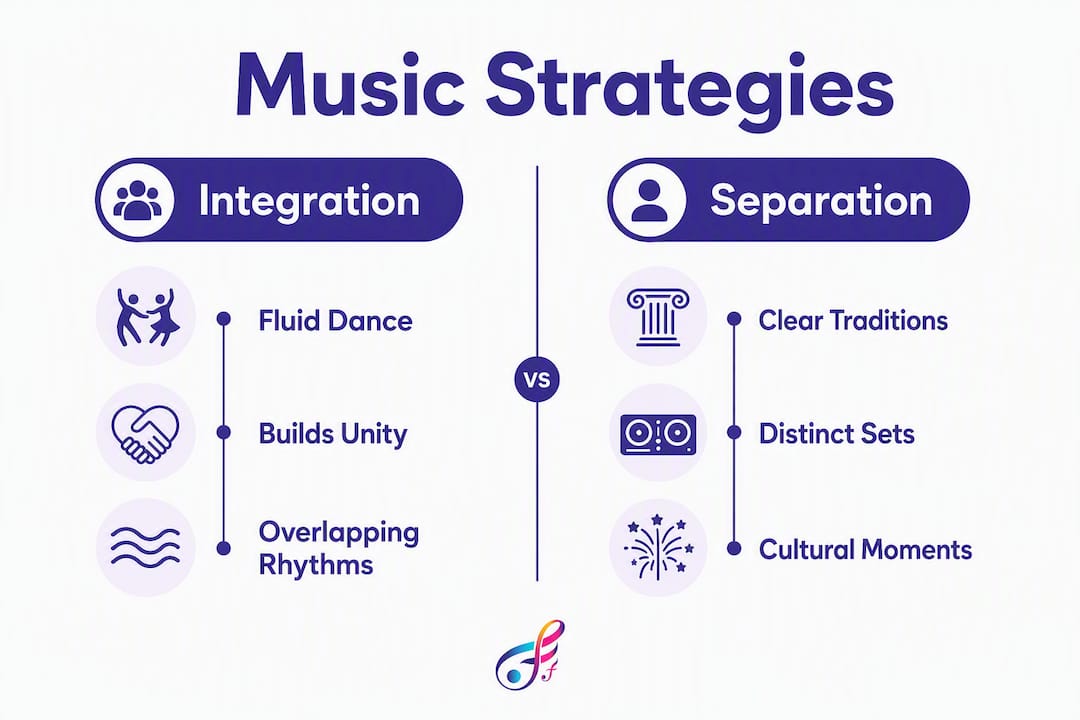
Event professionals warn that long, segregated hour-long blocks create an invisible barrier and cause guests from the other culture to disengage. Short, intentional sets avoid that entirely.
Pro Tip: To reduce perceived favoritism, alternate which culture opens each major set block. If Latin music opens the first reception set, South Asian music opens the second. Guests notice the pattern and feel respected.
Pro Tip: If one tradition has a specific performance moment (a circle dance, a live dhol player, a hora), protect that slot on the timeline and build the surrounding sets to lead into it naturally rather than dropping it in cold.
How do you structure sets to keep the dance floor packed?
The single most effective framework for cross-cultural wedding soundtracks is the grouped-set model: cluster cultural songs into short blocks, then follow each block with one or two universal bridge songs before the next cultural set begins.
A sample reception set order might look like this:
- Opening set (10–12 min): Two or three crowd-pleasing, broadly familiar songs to get people on the floor. Think Motown, classic pop, or a well-known crossover hit.
- First cultural set (5–7 min): Three to four songs from Culture A, building from moderate energy to high.
- Universal bridge (3–4 min): One or two songs that almost everyone knows, disco or top-40, to reset the floor and invite guests who sat out the cultural set.
- Second cultural set (5–7 min): Three to four songs from Culture B, same energy arc.
- Universal bridge (3–4 min): Another crowd-pleaser, slightly higher energy than the last.
- Peak block (10–15 min): Your highest-energy songs from both cultures, mixed together or in rapid alternation.
- Brief cooldown (5 min): A slower song or two to let guests catch their breath.
- Final push (10–12 min): Close with the most universally beloved songs from both traditions.
The energy arc matters as much as the song selection. Rise, short respite, peak, brief cooldown, then a strong close. Guests who leave the floor during a cultural set they don't know will come back if the bridge song is right.
For live bands, set length needs to account for instrument changes and any guest musician transitions. A band switching from a mariachi configuration to a standard pop setup needs at least 90 seconds. Build that into the timeline rather than treating it as dead air.
Pro Tip: Ask your DJ to flag the BPM of every cultural song you submit. Songs close in BPM can often be mixed directly; larger gaps need a bridge track to avoid a jarring tempo drop.
What music works best for each part of your wedding day?
Each segment of the day has a different emotional temperature, and the right cultural music placement depends on matching that temperature rather than forcing every tradition into the reception.
Ceremony Traditional and instrumental cultural pieces work best here. Processionals carry enormous emotional weight, and a live or recorded piece from each family's tradition honors that without requiring guests to know the song. If you want to blend languages in a vocal piece, choose one that has a universally understood emotional tone. A bilingual love song works; a culturally specific call-and-response chant may confuse guests who don't know the context.
Cocktail hour This is the best place to introduce cultural textures without pressure. Ambient fusion instrumentals, light acoustic versions of cultural songs, and low-key bilingual vocals give guests a chance to absorb the blend while they're talking and moving around. The stakes are lower here than on the dance floor.
First dance and parent dances Keep these deeply personal. If the couple's song is from one cultural tradition, that's fine. If you want a bilingual or adapted version, many DJs and music editors can create a custom edit that weaves two songs together. Parent dances are often where the most culturally specific songs live, and that's exactly right.
Reception dance sets
- Use the grouped-set model described above
- Plan at least one interactive cultural moment: a circle dance, a line dance, a traditional call-and-response
- Brief MC introductions before each cultural set help guests who aren't familiar with the tradition feel included rather than lost
- Keep niche requests for the late-night set, after the main energy arc is complete
Send-off Choose one song that either both families love or that has become "your song" as a couple. A high-energy, unifying number lands better than a culturally specific piece that half the guests won't recognize as a closing moment.
How do you choose the right DJ or band for a multicultural wedding?
The difference between a great multicultural reception and an awkward one usually comes down to the vendor. A skilled DJ actively manages energy rather than acting as a reactive jukebox, and that distinction matters most when the crowd is culturally mixed.
Vendor interview checklist:
- Ask for a sample mix or setlist from a multicultural wedding with similar cultural traditions to yours
- Request specific song examples from each culture you're incorporating, not just genre names
- Ask how they handle a moment when the dance floor empties during a cultural set
- Confirm bilingual MC capability and ask them to demonstrate pronunciation of key song titles or artist names
- Ask whether they use a guest-request platform and how they filter or approve requests on the night
- Confirm how they handle licensing for international music
Contract clauses to request:
- Custom song editing included or priced as a line item
- Specific cultural songs listed by name as guaranteed plays
- Rehearsal time for any live cultural performance moments
- Backup plan if a requested cultural musician cancels
- Overtime rate and process for extending the reception
Red flags to watch for:
- Sample playlists that are entirely one genre or one culture
- Reluctance to provide demos or references from multicultural events
- Vague answers about how they research unfamiliar cultural music
- No clear answer on licensing for international tracks
Experienced DJs research regional variations and artist nuance before attempting cultural sets, so the music feels authentic to elders and family members rather than a surface-level gesture. Ask directly: "How do you prepare for a cultural tradition you haven't worked with before?"
For live bands, versatile groups in multicultural cities typically handle three to five cultural styles confidently and often bring guest musicians for specific instruments like dhol or bouzouki. Ask whether they can source those musicians and whether the cost is included.
Pro Tip: Ask every DJ or band candidate to name three specific songs from each of your cultural traditions, not just the genre. A vendor who can name regional artists and specific recordings has done the work; one who names only the most famous mainstream hits probably hasn't.
A broader look at wedding entertainment options can help you decide whether a DJ, a band, or a hybrid setup fits your venue and budget before you start interviewing candidates.
What transition techniques actually keep the floor moving?
Rhythmic compatibility is the foundation of smooth multicultural transitions. Genre labels don't matter nearly as much as BPM and beat pattern alignment. A Bollywood percussion break and a reggaeton drop can flow directly into each other when the downbeats align, even though they come from completely different traditions.
Core transition techniques:
- BPM matching: Align the tempo of the outgoing and incoming songs within 5–10 BPM for a natural feel
- Rhythmic bridging: Find the shared beat pattern between two songs and use it as the transition point
- Key matching: Move between songs in compatible musical keys to avoid harmonic clashes
- Bilingual songs: Songs that naturally blend two languages (Spanish/English crossovers, for example) act as built-in bridges
- Mashups and remixes: Commission or find existing mashups that layer two cultural melodies over a shared beat
- Energy bridges: Use a 30–60 second instrumental or percussion loop to shift the crowd's attention before the new song drops
Specific editing requests to give your DJ:
- Trim the intro of a cultural song that starts too slowly for a dance floor context
- Add a drum cue or percussion hit at the end of one song to signal the transition
- Create a short crossfade between two songs that share a similar BPM
- Record a bridging loop using a percussion element from one culture that leads into the next
For live bands, rehearsing cultural performance moments is non-negotiable. A live dhol player joining the band for a 5-minute set needs at least one full rehearsal with the band to nail the cues and timing. Build that rehearsal into the contract.
Pro Tip: When you submit songs for editing, include a timestamp note like "cut intro at 0:22, fade out at 3:45." Your DJ can work faster and the edits will match your vision more closely than a general request.
Which tools make inclusive music planning easier?
Technology has made multicultural music curation significantly more collaborative. Guest-request platforms can democratize the process by letting both families vote on songs before the event, giving your DJ real-time data on which cross-cultural songs have the broadest appeal.
Useful workflows and tools:
- Pre-event request forms: Send a Google Form or a platform like WeddingWire's music planner to both families 4–6 weeks out, asking for song submissions by category (ceremony, cocktail, reception)
- In-event voting platforms: Apps like uRequest Live let guests vote on songs during the reception, which surfaces cross-cultural crowd-pleasers organically
- Curated family review playlists: Build a shared Spotify or Apple Music playlist for each family to review and comment on before the event
- Do-not-play list: Collect this from both families and load it into your DJ's platform before the night
When configuring a request app, ask your DJ to set filters that exclude songs on the do-not-play list and to cap the number of requests per guest so one family can't dominate the queue. Some platforms allow vote weighting, which can help balance representation between two family groups of different sizes.
DJ software features worth asking about:
- Tempo sync for smooth BPM transitions between cultural tracks
- Stem controls that let the DJ isolate vocals or percussion from a track
- Custom edit storage so pre-approved edits load instantly on the night
- Live looping for extending a percussion break during a cultural performance moment
On the night itself, designate one person (a coordinator, a trusted family member, or a second vendor) to monitor the request queue and flag anything that needs approval before it plays. Set a fallback rule in advance: if a requested song would drop the energy below a set threshold, the DJ defaults to the next universal bridge song on the approved list.
What does multicultural wedding music planning actually cost?
The timeline and budget for international wedding music planning depend on how complex your blend is, but most couples underestimate how early key decisions need to be locked in.
Planning timeline:
| Milestone | Timing |
|---|---|
| Submit must-play and do-not-play lists | 3 months before |
| Finalize custom song edits | 6–8 weeks before |
| Submit final set order and timing notes | 2–3 weeks before |
| Rehearsal for live cultural moments | 1–2 weeks before |
| Final walkthrough with vendor | 3–5 days before |
Typical cost components for a U.S. wedding:
| Service | Typical range |
|---|---|
| Travel fee (outside metro area) | $50–$200 |
These ranges reflect national averages for the U.S. market. Costs in major metro areas like New York, Los Angeles, or Chicago will trend toward the higher end; markets like Northern Utah will generally fall in the mid-range.
Checklist by milestone:
- 6 months out: Vendor booked, contract signed, must-play list drafted
- 3 months out: Must-play and do-not-play lists finalized, song edits requested
- 1 month out: Final set order reviewed, guest-request platform configured, rehearsal scheduled
What are the most common multicultural wedding music mistakes?
Most problems at multicultural receptions are predictable and fixable before the day arrives. The ones that aren't are usually caused by decisions made in the last 48 hours.
Common mistakes and immediate fixes:
- Hour-long single-culture blocks: Switch to the 3–8 minute grouped-set model. Long blocks cause the other family to disengage and rarely recover their energy.
- Trying to include every request: Focus on high-energy anthems that transcend cultural boundaries rather than exhaustive niche lists. A 200-song playlist with 40 niche tracks will clear the floor faster than a tight 80-song list.
- Unclear MC translations: If your MC is introducing a cultural moment in a second language, give them a written script with phonetic pronunciation. Improvised translations often miss the emotional context.
- Abrupt transitions: If a transition lands badly, the DJ should immediately drop a universal bridge song rather than pushing through to the next cultural track.
- Last-minute song swaps: Lock the setlist 2–3 weeks out. A song dropped the morning of the wedding that hasn't been edited or rehearsed will show.
Day-of action card for vendors and planners:
- If the floor empties during a cultural set, drop a universal bridge song immediately
- If energy stalls, call a family leader to the mic to invite their group to the floor
- If a requested song arrives that isn't on the approved list, default to the next bridge song and flag it for review at the next break
- If a live cultural musician is late or absent, have a recorded backup track ready to fill the slot
One practical note on licensing: playing international music at a U.S. event requires proper performance rights coverage. Ask your vendor directly how they handle licensing for international tracks, whether through a PRO blanket license (ASCAP, BMI, SESAC) or another arrangement. This is a vendor responsibility, but confirming it protects you.
What do experienced DJs actually recommend?
The practitioners who do this well share a consistent set of principles that go beyond playlist construction.
Reading the room and actively managing energy separates successful multicultural receptions from awkward ones. A DJ who follows requests without shaping the arc will inevitably favor whoever submits the most songs, which is rarely an equal split.
The grouped-set model works because it gives guests a predictable structure. When people know a cultural set is coming and know it will end, they're more likely to stay on the floor or return for the bridge song. Scattering single cultural tracks throughout the night creates confusion rather than inclusion.
The best multicultural receptions aren't the ones with the most songs from each culture. They're the ones where every guest felt like the music was speaking to them at least once during the night. That requires planning, not just a long playlist.
Practitioner case example: A reception alternating 6-minute Latin sets with 6-minute South Asian sets, separated by 3-minute Motown bridges, kept a 200-person mixed crowd on the floor for nearly two hours straight. The key wasn't the song selection alone. It was the MC's brief 20-second introductions before each cultural set that told guests what was coming and why it mattered.
Song-request technology adds a democratic layer that pure pre-planning can't replicate. When guests vote in real time, the songs that rise to the top are usually the ones with the broadest cross-cultural appeal, which is exactly what you want for the peak block.
Fiesta Fusion's DJs bring this same approach to weddings across Weber County, Davis County, and Salt Lake City, with experience managing culturally mixed guest lists and coordinating with live performers for quinceañeras, weddings, and corporate events.
Key Takeaways
Multicultural wedding music blending works best when you structure short cultural sets of 3–8 minutes, connect them with universal bridge songs, and hire a vendor with documented experience managing mixed-culture crowds.
| Point | Details |
|---|---|
| Start with family conversations | Collect must-play songs, do-not-play lists, and ceremonial timing from both families before booking a vendor. |
| Use the grouped-set model | Build 3–8 minute cultural sets and follow each with 1–2 universal bridge songs to reset the floor. |
| Hire for multicultural experience | Ask for demos, bilingual MC capability, and specific song knowledge from each tradition before signing a contract. |
| Lock decisions early | Finalize must-play lists 3 months out and submit song edits 6–8 weeks before the wedding. |
| Fiesta Fusion for Northern Utah couples | Fiesta Fusion provides wedding DJs with bilingual MC services, custom song editing, and cultural event experience across Weber County, Davis County, and Salt Lake City. |
What most guides get wrong about multicultural music planning
The conventional advice is to "honor both cultures equally," which sounds right but often leads couples to build a 50/50 playlist that satisfies no one. Equal time is not the same as equal impact.
What actually works is thinking about emotional peaks rather than minutes. One perfectly placed cultural moment, a live dhol player during the first reception set, a bilingual first dance, a circle dance that pulls both families onto the floor at the same time, will do more for inclusion than 45 minutes of alternating tracks that nobody dances to.
The other thing most guides underestimate is the MC's role. Music is half the equation. The person on the microphone shapes how guests receive each cultural moment. A brief, warm introduction before a cultural set tells guests who don't know the tradition that they're invited in, not excluded. Without that framing, unfamiliar music reads as a pause rather than a celebration.
The vendors who do this well aren't just music experts. They're event readers. They watch the floor, they adjust in real time, and they know when to push through a slow moment and when to pivot. That skill is harder to evaluate from a demo than repertoire is, which is why asking behavioral interview questions ("Tell me about a time the floor emptied and what you did") matters more than asking for a song list.
Fiesta Fusion brings this plan to life for Northern Utah couples
Planning a multicultural wedding in Northern Utah means finding a vendor who can handle the full picture: the cultural research, the custom edits, the bilingual MC work, and the energy management that keeps a mixed crowd moving all night.
Fiesta Fusion is a veteran-owned DJ and event company serving Ogden, Weber County, Davis County, and Salt Lake City. For multicultural weddings, that means wedding DJs with experience across cultural traditions, bilingual MC services, custom song editing, uplighting, and add-ons like a 360 video booth that give every guest a moment to celebrate. Fiesta Fusion also coordinates with live cultural musicians when a couple needs a dhol player, a mariachi group, or another live element woven into the reception.
Availability fills quickly for peak wedding season. Check dates and book at Fiesta Fusion to start building your multicultural music plan with a team that knows Northern Utah events.
Useful sources
These resources offer practical guidance on fusion wedding music planning, vendor evaluation, and set construction for couples and vendors working through multicultural receptions.
- How to Create a Multicultural Wedding Playlist That Keeps Everyone Dancing — Gold Country Entertainment's guide to grouped sets and universal bridge songs, with practical DJ-tested advice on energy management.
- How to Blend Cultures Through Music at a Multicultural Wedding — Segment-by-segment breakdown of where traditional, ambient, and high-energy cultural music fits best across the wedding day.
- The Ultimate Guide to a Multicultural Wedding Playlist for Bay Area Couples — Fog City DJs on reading the room, managing energy, and the difference between a reactive jukebox and an active floor manager.
- Crafting Multicultural Wedding Playlists That Wow Every Guest — Vinyllywed on researching regional variations and artist nuance so cultural sets feel authentic rather than performative.
- How to Plan Music for a Multicultural Wedding — uRequest Live on guest-request platforms, democratic playlist curation, and evaluating bands for multicultural repertoire.
- How to Build a Multicultural Wedding Playlist That Flows — Sondhi Sounds on rhythmic compatibility, BPM alignment, and why a Bollywood-to-reggaeton transition can work when the beat patterns align.
- Crafting the Perfect Multicultural Wedding Playlist — DJ XTC Entertainment on avoiding long segregated blocks and keeping both families engaged throughout the night.
- Family and Cultural Music Choices: Respectful Ways to Blend Traditions — Ready Entertainment on gathering family input respectfully and building a playlist that reflects both sides without conflict.
Note: Licensing for international music at U.S. events is the vendor's responsibility, but confirm with your DJ or band how they handle performance rights before signing a contract.
FAQ
How long should each cultural set be at a multicultural wedding?
Keep cultural sets to 3–8 minutes, roughly three to four songs. Shorter sets maintain energy and prevent guests from disengaging while longer ones risk clearing the floor.
What are the best bridge songs between cultural sets?
High-energy, broadly familiar songs work best: classic Motown, disco, or top-40 crossover hits. The goal is a song that almost everyone knows so the floor resets before the next cultural set begins.
How do you keep one culture from dominating the playlist?
Alternate which culture opens each major set block and use a guest-request platform that limits submissions per guest. A bilingual MC introducing each set also signals equal respect without requiring equal minutes.
What should you ask a DJ before booking for a multicultural wedding?
Ask for a sample mix from a similar multicultural event, request specific song names from each of your cultural traditions, confirm bilingual MC capability, and ask directly how they handle licensing for international music.
Can Fiesta Fusion handle multicultural wedding music in Northern Utah?
Yes. Fiesta Fusion provides wedding DJs with bilingual MC services, custom song editing, and experience coordinating cultural performance moments across Weber County, Davis County, and Salt Lake City.