TL;DR:
- Music influences guests' emotions at birthday parties by shaping energy levels and creating lasting memories. A deliberate playlist with appropriate tempo zones and age-appropriate mixes helps sustain engagement and avoid dead silence. Hiring a professional DJ provides real-time responsiveness and technical expertise for dance-focused events with diverse age groups.
Music is the emotional and energetic foundation of every birthday party, shaping how guests feel, move, and remember the celebration. The role of music at birthday parties goes far beyond background noise. It controls the pace of the event, drives guest interaction, and creates the emotional memories that outlast the cake and decorations. Research confirms that music creates lasting emotional connections, making moments more memorable than any visual element. Whether you are planning a child's first big party or an adult milestone celebration, music is not an afterthought. It is a core design decision.
How does music set the mood at different party phases?
Music pacing is the practice of matching song tempo to the emotional needs of each stage in your event. Most parties move through five distinct phases: background, build-up, peak, cooldown, and closing. Each phase demands a different energy level, and the right tempo delivers it.
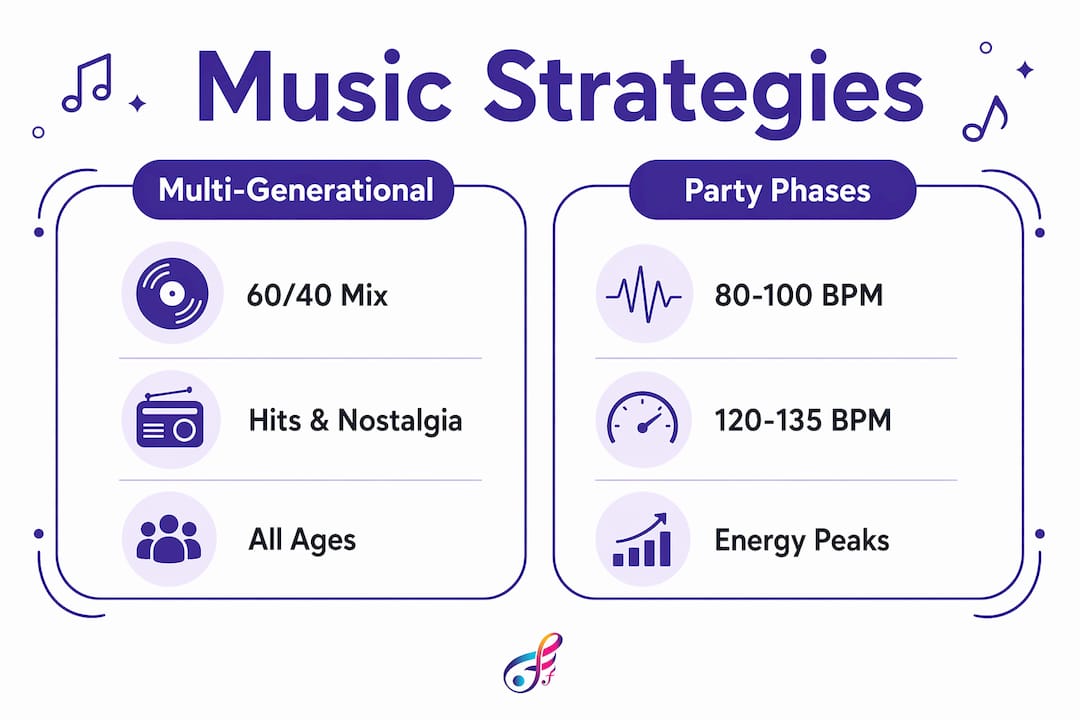
During the arrival and social phase, 80–100 BPM tracks work best. Songs at this tempo feel welcoming and relaxed, which encourages guests to talk and settle in without feeling pressured to dance. As the party builds toward its peak, tempo should climb to 120–135 BPM. According to current event planning guidance, peak-tempo music boosts movement by 40–60% compared to slower tracks. That is a significant jump in energy that you can feel in the room.
Professional DJs follow a deliberate energy curve. They build momentum gradually, starting with comfortable, familiar music and peaking after formal moments like the cake cutting. This prevents early burnout and keeps guests on the floor longer.
Pro Tip: Build your playlist to peak after the cake cutting, not before. Guests who have eaten and celebrated are far more likely to dance than guests who are still arriving and getting comfortable.
One often-overlooked rule is the 30% longer playlist standard. Your playlist should contain 30% more songs than your party duration requires. This gives you room to skip tracks that are not landing, extend songs that are working, and avoid dead silence if the event runs long. For a four-hour party, build a playlist that covers at least five hours of music.
What music selection strategies work for multi-generational parties?
Multi-generational birthday parties present the biggest music challenge. A 50-year-old parent and a 16-year-old cousin do not share the same taste, but they can share the same dance floor if the playlist is built correctly.
The most effective framework is the 60/40 split. Experts recommend 60% contemporary hits from the past five to six years paired with 40% nostalgia tracks tied to guests' formative years, typically ages 13–16. The nostalgia component is not random. Songs heard during those teenage years carry the strongest emotional recall, which means older guests will respond physically, not just politely.
The Sandwich Method takes this further. You alternate a classic track with a modern one, then repeat. Classic, modern, classic, modern. This keeps multi-generational guests engaged without creating long stretches that alienate one age group. A 1980s hit followed by a current pop track followed by a 1990s R&B song is a proven sequence that holds a mixed crowd together.
Crossover artists are another tool worth using. Artists like Bruno Mars, Adele, and Justin Timberlake blend genres and eras in ways that appeal across age groups. Their songs function as musical bridges between the contemporary and nostalgic halves of your playlist.
- Avoid age-based blocks. Never play 10 nostalgia songs in a row. Younger guests will disengage and leave the floor.
- Watch the room, not the clock. If older guests are dancing, do not switch to a modern track just because the schedule says so.
- Include one or two universally known anthems. Songs like "Don't Stop Believin'" or "Livin' on a Prayer" reliably pull every generation to the floor at once.
- Test your playlist before the party. Play it through a speaker at home and note where your own energy drops. Those are the tracks to replace.
| Approach | Best for | Key benefit |
|---|---|---|
| 60/40 contemporary and nostalgia split | Mixed-age adult parties | Balances familiarity with freshness |
| Sandwich Method | Parties with wide age gaps | Prevents alienation of any age group |
| Crossover artist anchors | All multi-generational events | Creates shared moments across generations |
When should you choose a professional DJ over a DIY playlist?
The answer depends on your party's primary goal. A playlist suits social-heavy or low-intensity gatherings where conversation is the main activity. A professional DJ is the right call when dancing and high energy are the point of the evening.
The core difference is real-time responsiveness. A static playlist cannot read the room. A professional DJ reads micro-signals from guests constantly, including body language, foot-tapping, and group movement, then adjusts tempo, genre, and volume on the spot. That level of responsiveness is what keeps a dance floor alive for three hours instead of thirty minutes.
Technical setup is another factor most party planners underestimate. For parties over 50 guests, speaker placement becomes critical. Poor placement creates dead zones where music sounds distant or muffled, which kills the energy in those areas of the room. Professional DJs handle this as part of their setup.
- Choose a DJ when: the party has a dedicated dance window, the guest count exceeds 50, or you want someone to handle all audio logistics.
- Choose a playlist when: the event is a small backyard gathering, conversation is the priority, or the budget does not allow for professional entertainment.
- Use a hybrid approach: run a curated playlist during arrivals and dinner, then bring in a DJ for the peak dance window. This gives you cost efficiency without sacrificing energy at the moments that matter most.
Pro Tip: If you go the playlist route for a larger party, rent a quality speaker system with at least two satellite speakers. One Bluetooth speaker in the corner of a 60-person room will not cut it.
For a deeper look at how professional DJs manage event music versus self-managed playlists, the DJ vs. playlist breakdown from Fiesta Fusion covers the key differences in practical terms.
How does music psychologically influence guests and shape memories?
Music does not just fill silence. It changes how guests think, feel, and behave. Research shows that music raises arousal and reduces critical evaluation of the environment. Guests become less self-conscious and more reactive to the energy around them. That is why the right song at the right moment can transform a quiet room into a full dance floor within 60 seconds.
The social proof effect amplifies this. When guests see others dancing to a familiar song, they are far more likely to join in. Familiar music lowers the social risk of dancing because it signals that the moment is shared. This is why familiar music encourages participation in ways that unfamiliar tracks simply cannot replicate, even if the unfamiliar track is technically better.
"Music should amplify existing energy rather than try to force a mood. The right song timing is key to successful events." — Event music psychology research
The memory connection is equally powerful. Songs heard at a birthday party become emotional anchors. Guests do not just remember what happened. They remember how they felt. That emotional recall is what makes a party truly memorable, and it is why immersive music experiences create lasting impressions that outlast the food, the decorations, and even the photos.
The practical implication is straightforward. Do not treat music as decoration. Treat it as the primary tool for shaping how guests experience every moment of the celebration.
Key Takeaways
Music is the single most powerful tool for shaping guest mood, energy, and lasting memories at any birthday party, and it requires deliberate planning to work.
| Point | Details |
|---|---|
| Use tempo zones by phase | Play 80–100 BPM for arrivals and 120–135 BPM for peak dancing to match guest energy naturally. |
| Build a 30% longer playlist | Extra songs prevent dead silence and give you flexibility to skip or extend tracks as needed. |
| Apply the 60/40 split | Mix 60% contemporary hits with 40% nostalgia tracks to keep multi-generational crowds unified. |
| Hire a DJ for dance-focused events | Professional DJs read real-time crowd cues and manage energy curves that static playlists cannot. |
| Music shapes emotional memory | Guests remember how a party felt, not just what happened, making song selection a lasting investment. |
What I have learned after years of watching music make or break a party
After working hundreds of events across Northern Utah, I can tell you the single most common mistake party planners make: they build a playlist they personally love instead of one the crowd needs. I have seen beautifully curated playlists fall completely flat because the person who built them did not account for the age range in the room or the energy arc of the evening.
The parties I remember most vividly are not the ones with the biggest budgets. They are the ones where the music felt intentional. One quinceañera in Ogden comes to mind immediately. The family had a mix of guests from age 8 to 75. The DJ started with soft Latin ballads during dinner, shifted to cumbia as the formal dances wrapped up, and then dropped into a mix of current reggaeton and 1990s pop hits for the open dance floor. Every generation was on the floor at some point. That does not happen by accident.
The other lesson I keep coming back to is this: silence is the enemy. Even a two-second gap between songs can break the spell. Guests notice it, even if they cannot name why the energy suddenly dropped. A professional DJ eliminates that risk entirely. A well-built playlist with crossfades does the same job for smaller events.
My honest advice to any parent or party planner reading this: spend as much time on your music plan as you do on your decorations. The decorations will show up in photos. The music will show up in how people feel when they drive home.
— Drew Deenie
How Fiesta Fusion brings the right sound to your birthday celebration
Planning the music for a birthday party is one thing. Executing it with the right equipment, the right pacing, and the right professional support is another.
Fiesta Fusion is a veteran-owned DJ and entertainment company serving Ogden, Weber County, Davis County, and Salt Lake City. The team specializes in birthday parties, quinceañeras, school dances, and corporate events, with custom playlist consultation and professional DJ services built around your specific crowd and venue. Beyond music, Fiesta Fusion offers 360 video booths and photo booth rentals that give guests something to do between songs and a physical memory to take home. For full birthday party planning support, visit Fiesta Fusion and see what the right entertainment team can do for your celebration.
FAQ
What is the role of music at birthday parties?
Music sets the emotional tone, controls energy levels, and shapes how guests interact throughout the event. It is the primary tool for creating lasting memories at any birthday celebration.
How long should a birthday party playlist be?
A playlist should be 30% longer than the party duration. For a four-hour party, build at least five hours of music to allow for skipping tracks and handling overruns without silence.
What BPM works best for birthday party dancing?
Tracks in the 120–135 BPM range work best for peak dancing. Use 80–100 BPM during arrivals and social hours to encourage conversation without pressure to dance.
When does hiring a DJ make more sense than using a playlist?
A professional DJ is the better choice for dance-focused parties with more than 50 guests. DJs read real-time crowd cues and adjust tempo and volume instantly, which a static playlist cannot do.
How do you keep all ages happy on a birthday party playlist?
Use a 60/40 split of contemporary hits and nostalgia tracks, and apply the Sandwich Method by alternating classic and modern songs. This keeps every generation engaged without long stretches that alienate one age group.