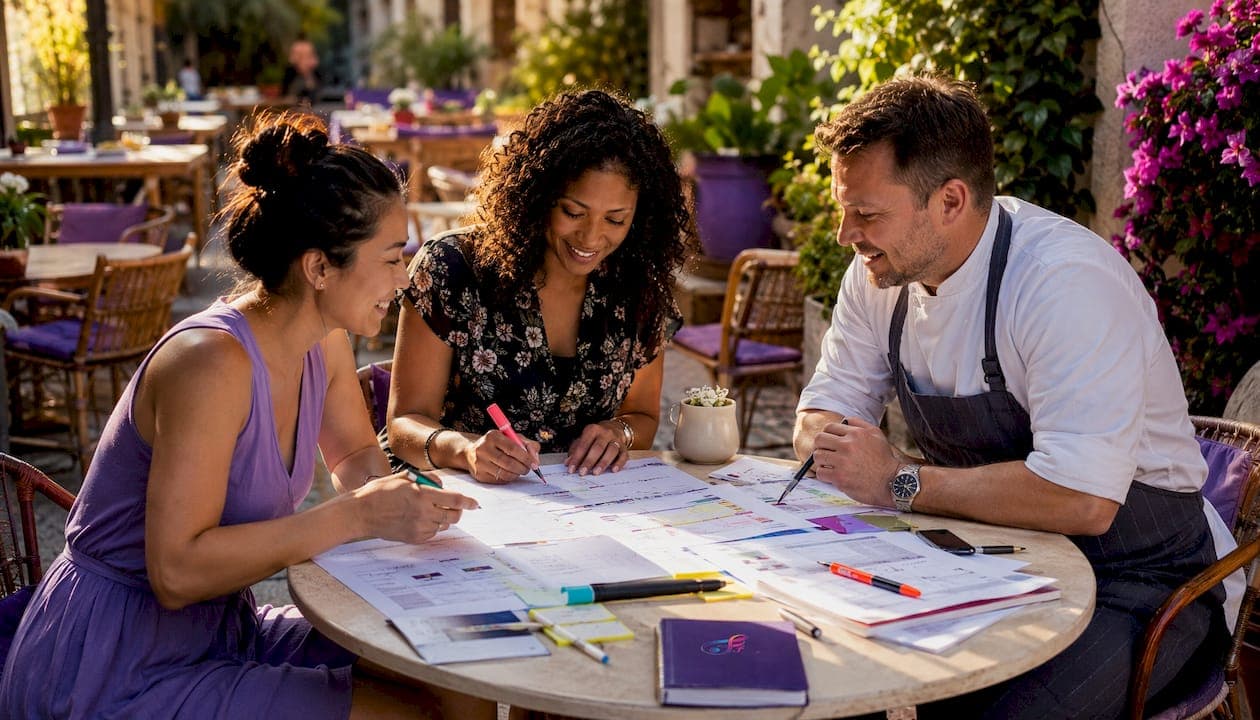
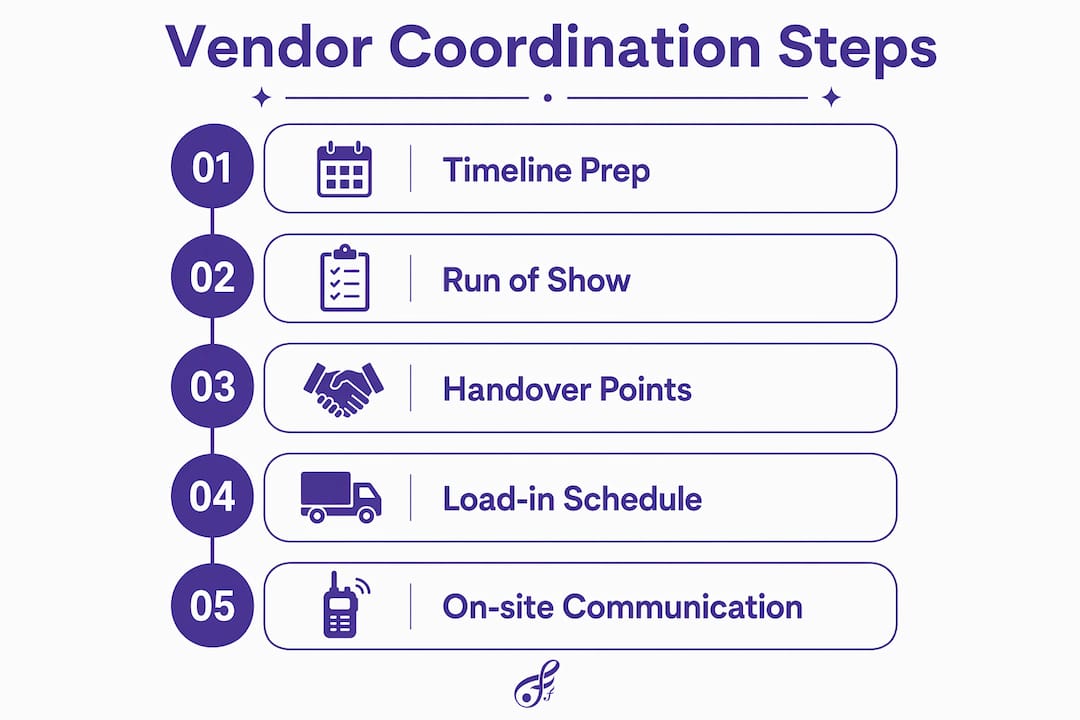
Vendors coordinate by working from one shared master document that separates the long-term project timeline from the minute-by-minute run of show. Clear roles, scheduled handover points, and a single on-site communication channel keep teams from colliding. Here is what that looks like in practice:
- Every vendor receives the same locked run of show, a vendor contact sheet, and a confirmed setup window before event day.
- On site, two-way radios handle real-time cues; a designated showrunner fields all operational questions so the couple stays out of it.
- A three-wave confirmation protocol at 30 days, 7 days, and 48 hours out catches problems before they become day-of disasters.
Pro Tip: Ask every vendor to confirm their setup window and run-of-show sign-off in writing. If a vendor cannot answer those two questions, that is a red flag worth addressing before you sign anything.
Table of Contents
- How event vendors coordinate around a single master document
- Who owns what: roles, responsibilities, and handover points
- How to build a load-in schedule that prevents collisions
- On-site communication: what actually works when things go sideways
- AV, power, and photo booth footprint requirements
- Common problems, contingencies, and vendor red flags
- Questions to ask your DJ and photo booth vendor
- How Fiesta Fusion coordinates events in Northern Utah
- Key Takeaways
- The part most couples underestimate about vendor coordination
- Fiesta Fusion handles the coordination so you do not have to
- Useful sources and further reading
- FAQ
How event vendors coordinate around a single master document
Two documents do the heavy lifting: the project timeline and the run of show. They are not the same thing, and confusing them is where most coordination breaks down.
| Document | Purpose | Owner | Audience | Lock Timing |
|---|---|---|---|---|
| Project timeline | Tracks tasks weeks to months out | Planner or couple | All vendors | 4 weeks before event |
| Run of show | Minute-by-minute event-day cues | Showrunner | Day-of vendors | 7 days before event |
The project timeline tracks deposits, fittings, venue walkthroughs, and vendor confirmations. The run of show is what every vendor actually reads on event day. Here is a sample snippet:
| Time | Cue | Owner |
|---|---|---|
| — | DJ and photo booth arrive, load-in begins | DJ lead |
| — | Venue locked for photography setup | Venue manager |
| 5:30 PM | Doors open, cocktail hour music starts | DJ lead |
| — | Grand entrance cued | Showrunner |
| — | First dance | DJ lead |
| — | Toasts begin, DJ lowers music | Showrunner |
| — | Cake cutting, photo booth opens | Photo booth lead |
| — | Last song cued | DJ lead |
Pro Tip: Version-control the run of show with a date stamp in the filename. Send the final locked version to all vendors simultaneously so no one is working from an older draft.
Who owns what: roles, responsibilities, and handover points
Conflating responsibilities between venue staff and entertainment teams is one of the most common sources of friction. A clean role map prevents it.
- Showrunner: calls all cues, manages timeline deviations, shields the couple from operational issues
- Venue manager: controls access, enforces noise limits, approves power usage
- DJ lead: manages audio, announcements, and music cues; coordinates with photographer before each formal moment
- Photo booth lead: handles booth setup, props, and guest flow; confirms power circuit with DJ lead
- Catering lead: coordinates meal service timing with showrunner; confirms vendor meal windows
- Photography lead: communicates shot list timing to DJ and showrunner
Handover points are the operational control that prevents teams from working on top of each other. Schedule them explicitly:
| Time | Handover | From | To |
|---|---|---|---|
| — | Decor complete, space locked | Florist | Photography |
| 5:30 PM | Photography done, entertainment active | Photo lead | DJ lead |
| — | Catering service opens | Catering lead | Showrunner |
Keep a contact sheet with three columns: role, name, and cell number. Separate it into technical (DJ, booth, AV), hospitality (catering, venue), and emergency (venue manager, showrunner).
How to build a load-in schedule that prevents collisions
Reverse-engineer every schedule from the ceremony or main anchor event. Work backward, assigning each vendor an arrival window, a setup duration, and a hard handover time.
| Vendor | Arrival | Setup Duration | Handover |
|---|---|---|---|
| Florist / decor | — | — | 2:30 PM |
| DJ and photo booth | 2:30 PM | — | — |
| Catering | — | 2 hours | — |
| Photography | — | 1 hour | — |
Build a 20-minute buffer between every handover. Traffic on I-15 through Davis County or a slow freight elevator at a Weber County venue can eat that buffer fast. Without it, one late vendor cascades into every team behind them.
- Confirm load-in access with the venue at least two weeks out.
- Identify whether a freight elevator or service entrance is required.
- Assign parking spots for vendors with heavy equipment.
- Confirm whether the venue has a hard vendor-out time after the event.
On-site communication: what actually works when things go sideways
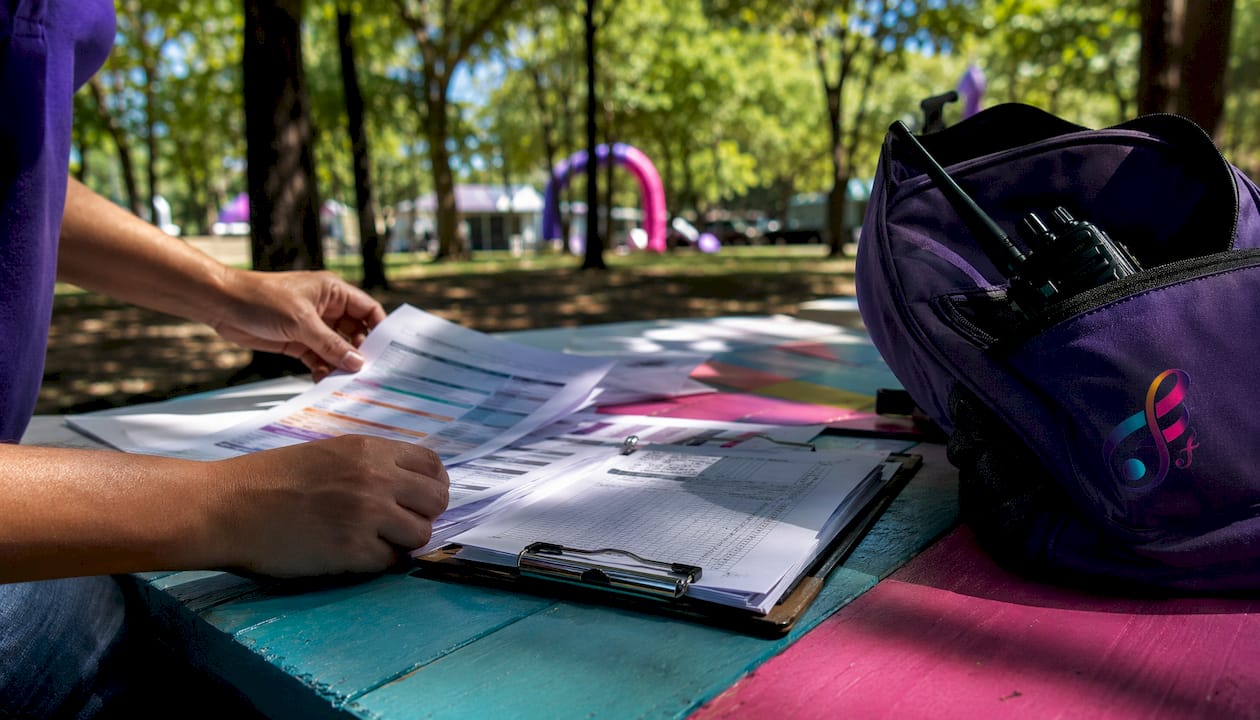
Two-way radios are the gold standard for live event cues. Phones require unlocking, typing, or calling, all of which cause delays during a live transition. Radios are push-to-talk and instant.
Radio equipment checklist:
- One radio per team lead (showrunner, DJ, photo booth, venue manager, catering)
- Spare batteries or a charging station on site
- A single designated channel for all vendor communication
- A backup channel in case of interference
Radio protocol:
- Use short call signs: "DJ to showrunner, grand entrance ready."
- Confirm with a single word: "Copy."
- Escalate only to the showrunner, never to the couple.
For non-urgent coordination, a WhatsApp group created one week before the event works well. Share the final run of show, access maps, and any last-minute updates there. Every vendor can refer back to it without calling anyone.
Pro Tip: If radios fail, the fallback is direct cell-to-cell between team leads only. Brief every lead on this before the event starts so no one is improvising when it matters.
AV, power, and photo booth footprint requirements
DJ and photo booth teams must confirm power circuit assignments before event day. Running both off the same circuit is the fastest way to trip a breaker mid-reception.
Power checklist:
- DJ audio: dedicated 20-amp circuit minimum
- Photo booth: separate dedicated circuit, independent from audio load
- Uplighting: third circuit or confirm draw with venue electrician
- Surge protectors on all equipment
- Labeled extension cords so venue staff can identify them quickly
Booth footprint template:
| Dimension | Minimum Clearance |
|---|---|
| Guest queue space | — in front |
| Side clearance | 3 feet each side |
Place the booth within sight of the dance floor but away from the speaker stacks. Guests should be able to hear the DJ from the booth area without the audio being so loud it disrupts the photo experience. Confirm the placement on a venue floor plan before event day. For ideas on how event enhancements like 360 booths fit into a reception layout, the Fiesta Fusion blog covers placement and traffic flow in detail.
Common problems, contingencies, and vendor red flags
Top day-of failures:
- Timing overrun from a previous event leaves vendors with a shortened setup window.
- Power conflict trips a breaker when audio and booth share a circuit.
- Venue access is blocked because load-in was not confirmed in writing.
- A vendor is unreachable in the 48-hour window before the event.
- Last-minute layout change moves the dance floor without notifying the DJ or booth.
Incident response when a cue is missed:
- Alert the showrunner immediately via radio.
- Showrunner activates the buffer window built into the run of show.
- Adjust all subsequent cue times by the same offset.
- Log the change in the WhatsApp group so all leads have the updated timing.
Red flags during vendor vetting:
- No written confirmation of setup window or power requirements
- Cannot name a backup plan for equipment failure
- Unresponsive to messages in the 48-hour confirmation window
- No run-of-show sign-off process
For a practical framework on evaluating entertainment vendors, Dreamscape's vendor evaluation guide covers the criteria worth checking before you commit.
Questions to ask your DJ and photo booth vendor
Use this checklist during your vendor calls and before final sign-off:
- What is your confirmed arrival time and teardown window?
- Do you require a dedicated power circuit, and what is the amperage draw?
- Do you carry two-way radios, and will you join the vendor communication channel?
- Will you sign off on the run of show at least 7 days before the event?
- What is your replacement policy if a team member cannot attend?
- What is your overtime rate if the event runs past the contracted end time?
- Who is your on-site lead, and what is their direct cell number?
- What is your liability policy for power shortages or venue-caused equipment failure?
- Do you provide a vendor packet with your floor plan, power map, and contact sheet?
For a broader look at wedding entertainment options and what to compare across providers, the Fiesta Fusion guide covers the full inventory.
How Fiesta Fusion coordinates events in Northern Utah
Fiesta Fusion's standard pre-event process covers the items that prevent the most common day-of failures. Every booking includes a timeline lock, a vendor packet with a contact sheet and power map, and a site walkthrough for venues where load-in or power access is not straightforward.
For a typical Weber County wedding, the coordination sequence looks like this:
- 30 days out: run of show drafted, setup window confirmed with venue
- 7 days out: vendor packet sent to all team leads, power circuit assignments confirmed
- 48 hours out: final check-in call, radios charged, backup equipment loaded
- Day of: DJ and photo booth arrive together, share a load-in window, and join the vendor radio channel before guests arrive
Bundled DJ and photo booth teams reduce coordination overhead because both operate on one communication lane with a shared floor plan. That means one fewer vendor relationship for the couple to manage and one fewer setup overlap to schedule around.
Pro Tip: Ask your entertainment vendor whether their DJ and booth team share a single point of contact. If they do not, you are managing two separate coordination threads on event day.
Key Takeaways
Successful event vendor coordination comes down to one locked run of show, explicit handover points, dedicated power circuits, and a showrunner who keeps the couple out of operational decisions.
| Point | Details |
|---|---|
| Lock the run of show early | Send the final version to all vendors 7 days before the event, date-stamped. |
| Assign handover points, not open windows | Schedule the exact time each team finishes so the next can begin without overlap. |
| Separate power circuits | DJ audio and photo booth must run on independent circuits to prevent tripped breakers. |
| Use radios for live cues | Two-way radios beat phones for instant push-to-talk communication during transitions. |
| Fiesta Fusion bundles coordination | DJ and booth operate on one communication lane with a shared floor plan and vendor packet. |
The part most couples underestimate about vendor coordination
Most couples focus on choosing the right vendors individually. The coordination layer between them gets almost no attention until something goes wrong. A late florist who runs over their window does not just delay the florist. It compresses the DJ's setup time, which compresses the sound check, which means the first dance audio is not tested before guests walk in.
The run of show is not a formality. It is the document that lets every vendor make a decision independently without calling the couple. When it is built well, the showrunner can absorb a 15-minute delay and redistribute it across the buffer windows without anyone noticing. When it is missing, every vendor improvises, and improvisation at a wedding tends to compound.
Local venues in Ogden and Weber County add a specific wrinkle: freight elevator access and parking for heavy equipment are not always confirmed until the week of the event. A vendor who has worked those venues before knows to ask about it at booking, not the morning of load-in. That local knowledge is worth more than any checklist.
Fiesta Fusion handles the coordination so you do not have to
Fiesta Fusion is a veteran-owned DJ and photo booth company based in Ogden, and the coordination work described in this article is built into every booking. Clients get a pre-event vendor packet, a locked run of show, and a team that arrives together and joins the venue's communication channel from the first minute of load-in.
The service area covers Ogden, Weber County, Davis County, and Salt Lake City. Whether you need a wedding DJ, a 360 photo booth in Ogden, uplighting, or a bundled entertainment package, Fiesta Fusion handles the technical coordination so the couple can focus on the celebration. Request a vendor packet or check availability at fiestafusion.com.
Useful sources and further reading
- Wedding vendor coordination: essential tips for your big day — Lovestory Magazine; covers two-way radio protocols and real-time communication systems for wedding vendors.
- How to coordinate wedding vendors like a pro — Abastio Blog; covers reverse-engineered scheduling and the three-wave confirmation protocol.
- Vendor coordination on the day — The Wedding Trunk; explains handover points and setup sequencing.
- Wedding management: a simple system for vendors and guests — Revel; covers vendor packets and showrunner escalation paths.
- Perfect wedding DJ and photo booth setup — 1021 Events; covers power circuit assignments and bundled entertainment coordination.
- What is event coordination? A practical guide — Fiesta Fusion Blog; overview of coordination fundamentals and entertainment vendor roles.
FAQ
What is a run of show and why do vendors need it?
A run of show is a minute-by-minute schedule for event day that tells every vendor exactly when their cues happen and who they report to. It is the single document that lets vendors make decisions independently without contacting the couple.
How far in advance should vendors receive the final timeline?
Send the locked run of show to all vendors at least 7 days before the event, with a final 48-hour confirmation check to catch any last-minute changes or non-responders.
Do a DJ and photo booth need separate power circuits?
Yes. Running both off the same circuit risks tripping a breaker mid-reception. The DJ audio load and the photo booth should each have a dedicated circuit confirmed with the venue before event day.
What should a vendor contact sheet include?
List every team lead by role, name, and direct cell number, grouped into three categories: technical (DJ, booth, AV), hospitality (catering, venue), and emergency (showrunner, venue manager).
How does Fiesta Fusion handle day-of coordination?
Fiesta Fusion sends a pre-event vendor packet covering the run of show, power map, and contact sheet, then arrives with the DJ and booth team together to share one load-in window and join the venue's radio channel before guests arrive.