
Book your Utah wedding vendors in this order: venue first (12–18 months out), then photographer, planner, and caterer (12–15 months), then florist, officiant, and hair and makeup (8–12 months), then entertainment and rentals (6–9 months), then stationery, cake, and transportation (4–8 months). May, June, September, and October are peak months in Utah, and Saturday dates in those windows disappear fast.
Here is where to start right now:
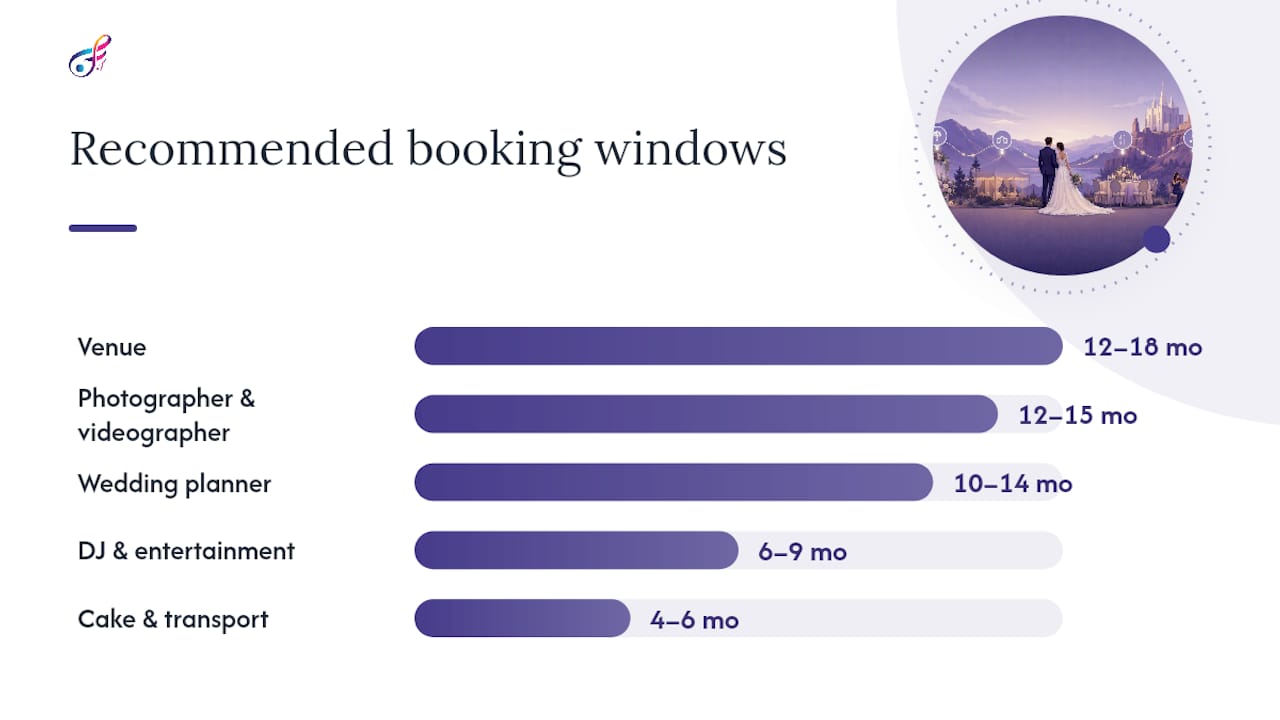
- Venue: 12–18 months out; sets your date and guest count before anything else
- Photographer and videographer: 12–15 months out; top shooters limit bookings per season
- Wedding planner and caterer: 10–14 months out; planners help sequence everything else
- Entertainment (DJ, photo booth, band): 6–9 months out; weekends fill faster than most couples expect
- Florist, officiant, hair and makeup: 8–12 months out; earlier booking reduces substitution risk on flowers
- Stationery, cake, transportation: 4–8 months out
Peak-season alert: May, June, September, and October are the busiest months across Utah. If your date falls on a Saturday in any of those months, add two to three months to each window above.
Your next step: confirm your wedding date and start venue tours this week. Every other vendor decision flows from that one.
Pro Tip: Utah's engagement season peaks between Thanksgiving and Valentine's Day. If you get engaged in November or December, start venue outreach in October of the year before your target wedding date to beat the rush.
Key Takeaways
Book your Utah wedding vendors in priority order, starting with the venue 12–18 months out, and work down the list so each booking informs the next.
| Point | Details |
|---|---|
| Venue comes first | The venue sets your date, guest count, and logistics before any other vendor can be confirmed. |
| Peak months need more lead time | May, June, September, and October Saturdays fill 12–18 months out; add extra time to every window for those dates. |
| Entertainment books at 6–9 months | DJs and photo booths fill peak weekends fast; contact vendors directly with your date, venue, and guest count ready. |
| Marriage license timing | Apply 10–14 days before the wedding; Utah's digital license has no waiting period and expires in 32 days. |
| Fiesta Fusion for Northern Utah | Fiesta Fusion provides wedding DJs, 360 video booths, and event enhancements across Weber County, Davis County, and Salt Lake City. |
Official and helpful resources for Utah couples
- Utah County Clerk Marriage License Portal: the official online application for Utah County marriage licenses, including ID requirements and payment instructions
- How to Plan a Utah Valley Wedding: A Month-by-Month Timeline: local guidance on vendor sequencing and two-part celebration logistics for Utah Valley couples
- When to Book Your Wedding Vendors: The Ultimate Timeline: detailed booking windows by vendor type with peak-season notes
- WeddingClever Booking Tips: practical roadmap for tiered vendor booking from 12 months out through final logistics
- What Utah Wedding Vendors Get Booked First: local insight on engagement-season timing and why October outreach matters
Table of Contents
- What does the Utah wedding vendor booking timeline look like month by month?
- How early should you book your photographer and videographer in Utah?
- When should you book a wedding planner and caterer in Utah?
- Which vendors should you book 8–12 months before your Utah wedding?
- When should you book your DJ and entertainment for a Utah wedding?
- When should you order wedding stationery and book your cake?
- What should you confirm with vendors 30–60 days before your Utah wedding?
- What needs to happen in the final 2–4 weeks before your Utah wedding?
- What should you do if you have 90 days or less to plan your Utah wedding?
- How do you choose the right vendors and avoid contract mistakes?
- How do you get a Utah marriage license, and when should you apply?
- What do Utah vendors say about booking timing and common mistakes?
- A note from a local entertainment provider
- Fiesta Fusion: DJ and photo booth services for Northern Utah weddings
- Sources
- FAQ
What does the Utah wedding vendor booking timeline look like month by month?
12–18 months out: venues and high-demand bookings
The venue is not just the first booking. It is the decision that makes every other booking possible. Once you sign a venue contract, you have a date, a guest count ceiling, and a set of logistical constraints (parking, catering exclusivity, load-in windows) that shape every vendor conversation after it.
Popular venues in Utah and similar peak-season markets book out 12 to 18 months ahead for prime weekend dates, especially May through October. A venue that looks available in January may have a waiting list by March once engagement-season couples start calling.
What to do during this window:
- Tour at least three venues before committing; ask each about exclusive vendor lists and catering minimums
- Request a "soft hold" on your preferred date while you review the contract; most venues will hold for 48–72 hours
- Ask about backup dates in case your first choice is unavailable
- Once you sign, immediately contact your photographer and planner, since their calendars fill on the same timeline
Pro Tip: Ask the venue coordinator which other vendors they see booked most often on your date. Venue staff track conflicts and can flag if a popular caterer or entertainment company is already reserved for a nearby event that day.
Booking window reality check: Top vendors and venues in peak season typically require a 12–18 month lead time for the best dates. For a June Saturday in Utah, that means starting your search in June of the prior year.
How early should you book your photographer and videographer in Utah?
12–15 months out: photographers, videographers, and creative team
Top-tier photographers in Utah often cap their bookings at a set number of weddings per season. If you have a specific photographer in mind, contact them the same week you sign your venue contract. Waiting even a month can cost you the slot.
During consultations, ask:
- How many weddings do you shoot per weekend?
- Do you have a second shooter, and is that included?
- What is your turnaround time for galleries?
- What are your travel fees for venues outside your base area?
- What happens if you have an emergency on our wedding day?
Contract checklist before you sign:
- Confirm the exact date, hours of coverage, and overtime rate
- Verify the deposit amount and payment schedule
- Check the cancellation and rescheduling policy
- Confirm who owns the image files and what print rights you receive
- Ask whether engagement session photos are included or priced separately
Engagement sessions are worth scheduling 6–9 months before the wedding. That timing gives you photos for save-the-dates while also letting you get comfortable in front of the camera before the big day.
Style fit matters as much as availability. Look at full wedding galleries, not just highlight reels. A photographer who shoots moody, dark-toned images will not suddenly deliver bright airy photos because you asked nicely.
Pro Tip: Book your videographer at the same time as your photographer. Many videographers coordinate directly with photographers on shot lists and positioning, and the best ones in Utah fill their calendars just as quickly.
When should you book a wedding planner and caterer in Utah?
10–14 months out: planners, caterers, and vendors with inventory lead time
A planner hired at this stage can help you sequence every remaining vendor decision, negotiate contracts, and catch conflicts before they become expensive. In Utah's fast-paced market, local experts recommend front-loading high-demand vendor decisions while staying flexible on smaller details. A planner is the person who keeps that balance.
Caterers need this much lead time because menu planning, tastings, and staffing all require runway. Most Utah caterers schedule tastings 6–9 months before the event, but they book the date itself much earlier. If your venue has an exclusive caterer list, you may have fewer options than you think.
Key questions for caterers:
- What is your per-person minimum, and does it include service staff?
- How do you handle dietary restrictions and allergies?
- When is the final guest count due, and what is the overage policy?
- Do you provide rentals (linens, chargers, serving equipment), or do we source those separately?
Rental inventory (chairs, tables, linens, specialty items like arches or lounge furniture) books on a similar timeline. Popular rental companies in Utah hold inventory for peak weekends months in advance. Ask about minimums, delivery fees, and setup charges upfront.
Pro Tip: Ask every vendor about blackout dates, seasonal surcharges, and holiday-weekend premiums. A September Saturday near Labor Day or a June date near Father's Day can carry higher rates that are not always listed on a vendor's website.
Which vendors should you book 8–12 months before your Utah wedding?
8–12 months out: hair and makeup, florist, officiant, and ceremony details
Hair and makeup artists who work weddings in Utah often take multiple clients per day, but they cap the number of people in a bridal party. If you have six bridesmaids plus yourself, you need an artist who can handle that volume or a team of two. Book early and confirm the exact number of people being styled.
Florists at this stage need your color palette, rough guest count, and a sense of your aesthetic. Seasonal flower planning matters more than most couples realize. Peonies peak in late May and early June; dahlias are at their best in September. Booking your florist early reduces the risk of substitutions when your first-choice blooms are not available.
Florist consultation checklist:
- Bring inspiration photos and a rough budget range
- Ask about seasonal availability for specific flowers
- Confirm whether the florist handles setup and breakdown
- Ask about delivery fees and whether they work with your venue's load-in window
Officiant considerations:
- Popular officiants in Utah book 10–12 months out for peak weekends
- If you are planning a Utah Valley two-part celebration (temple sealing plus reception), prioritize a coordinator familiar with that flow; the timing between the two events requires careful vendor sequencing
- Confirm whether your officiant files the marriage license paperwork or whether you handle that separately
Pro Tip: If you are using multiple vendors for setup (florist, rental company, entertainment), ask each one about their delivery window and consolidate where possible. Fewer delivery windows mean less day-of traffic at the venue and lower setup fees.
When should you book your DJ and entertainment for a Utah wedding?
6–9 months out: entertainment, rentals, and rehearsal logistics
Saturday evenings in Utah's peak months are the most competitive entertainment slots. A practical booking roadmap places rentals and entertainment at 6–9 months out, but for a peak-season Saturday, earlier is safer. A DJ or band that is still available six months before a June Saturday is either new or had a cancellation.
What to confirm with your entertainment vendor:
- Do you carry backup equipment on-site?
- What time do you arrive for sound check, and how long does setup take?
- Do you need a vendor meal, and when should it be served?
- What is your overtime rate if the reception runs long?
- Can you coordinate with the venue's AV system, or do you bring your own?
For rental companies, confirm delivery and pickup windows, setup and breakdown responsibilities, and whether they require a venue walkthrough before the event.
Sample vendor arrival order for a 5:00 PM reception:
| Time | Vendor | Task |
|---|---|---|
| 10:00 AM | Rental company | Tables, chairs, linens delivery |
| — | Florist | Centerpieces and ceremony florals |
| 12:00 PM | Entertainment (DJ/photo booth) | Equipment setup and sound check |
| 2:00 PM | Caterer | Kitchen setup and food prep |
| 3:30 PM | Hair and makeup final touch-ups | Bridal suite |
| 4:30 PM | Photographer and videographer | Venue detail shots |

Pro Tip: When you call a DJ or photo booth company, have your venue name, date, start time, and approximate guest count ready. That information determines whether they can physically accommodate your event before any other conversation happens.
When should you order wedding stationery and book your cake?
4–8 months out: stationery, cake, transportation, and smaller vendors
Custom stationery takes longer than most couples expect. A full suite (save-the-dates, invitations, RSVP cards, menus, programs) from a custom designer can take 6–10 weeks from proof approval to delivery. Order at the 6–8 month mark to give yourself time for revisions.
Stationery and invitation mailing timeline:
| Item | When to mail |
|---|---|
| Save-the-dates | 6–8 months before the wedding |
| Invitations | 6–8 weeks before the wedding |
| RSVP deadline | 3–4 weeks before the wedding |
| Final guest count to caterer | 1–2 weeks before the wedding |
Cake tastings at most Utah bakeries are scheduled 4–6 months out. Custom cakes with intricate sugar work or tiered designs need more lead time than simple buttercream styles. Book the tasting early, but you do not need to finalize the design until 2–3 months before the wedding.
Transportation (shuttle buses, vintage cars, luxury vehicles) books on a similar timeline. If you need a shuttle for guests between a hotel and the venue, confirm capacity and route logistics at least 4 months out.
Pro Tip: Use a digital RSVP option alongside your paper invitation. Platforms like Zola or The Knot let guests respond online, which speeds up your final count and reduces the time you spend chasing paper RSVPs.
What should you confirm with vendors 30–60 days before your Utah wedding?
30–60 days out: confirmations, timeline sharing, and final logistics
This window is about locking everything down. Every vendor you booked months ago needs a reconfirmation call or email with your updated timeline, final guest count, and any changes since you signed the contract.
Final confirmation checklist:
- Send the finalized day-of timeline to every vendor
- Confirm arrival times, load-in windows, and parking logistics with each vendor
- Share dietary notes and final guest count with the caterer
- Confirm the vendor contact sheet with names and cell numbers for every person working your event
- Verify that all balances are paid or scheduled per contract
Who should receive the final timeline: your venue coordinator, planner (if you have one), photographer, videographer, DJ or band, caterer, florist, and transportation company. If you have a photo booth, they need it too.
Communication cadence: reach out to each vendor once at 60 days and again at 30 days. If a vendor does not respond within 48 hours, follow up by phone. Silence at this stage is a red flag worth addressing immediately.
Pro Tip: Designate one person (your planner, a trusted family member, or your venue coordinator) as the single point of contact for day-of logistics. Every vendor should have that person's cell number, not yours. You should not be answering vendor questions on your wedding day.
What needs to happen in the final 2–4 weeks before your Utah wedding?
2–4 weeks and the week-of: last-minute checks and the day-before plan
Two-to-four-week checklist:
- Confirm final guest count and send it to the caterer and venue
- Finalize vendor arrival windows and share the updated timeline
- Collect emergency contact numbers for every vendor
- Confirm transportation pickup times and drop-off locations
- Prepare vendor payments (tips, final balances) in labeled envelopes
Week-of plan:
- Do a venue walkthrough with your planner or point person
- Distribute the vendor contact sheet to your wedding party and point person
- Prepare a day-of emergency kit (safety pins, stain remover, pain reliever, phone charger, snacks)
- Confirm rehearsal time and location with your officiant and wedding party
- Charge all devices and download any vendor apps you need for day-of communication
Day-of checklist for your point person:
- Vendor contact sheet with cell numbers
- Printed day-of timeline with arrival windows
- Venue access codes or parking passes for vendors
- Tip envelopes labeled by vendor
- Emergency kit location
Pro Tip: Send a vendor arrival order and contact sheet to every single vendor the week before the wedding. When each vendor knows who else is arriving and when, they coordinate among themselves and you stay out of the middle.
What should you do if you have 90 days or less to plan your Utah wedding?
A three-month timeline is tight but workable, especially for weekday dates, off-season months (November through April), or smaller guest counts. The trade-offs are real: you will have fewer venue options, less photographer availability, and limited customization on stationery and florals. Where you cannot compromise is on the venue, photographer, and officiant. Everything else has a workaround.
Compressed three-month priority order:
- Venue: call immediately and ask specifically about cancellation openings
- Officiant: many are available on shorter notice than photographers
- Photographer: ask about cancellation lists and associate shooters
- Caterer: look for venues with in-house catering to cut one booking step
- Entertainment: off-season or micro-wedding dates can sometimes secure top vendors in 4–6 months, occasionally with reduced pricing
- Florist: simplify the floral design to reduce lead time; a single statement arrangement is faster to source than a full floral program
- Stationery: go digital for invitations; paper save-the-dates are not necessary at this stage
Where you can compromise:
- Custom stationery: use digital invitations or simple printed templates
- Elaborate decor: focus on one or two statement pieces rather than full room styling
- Specialty rentals: work with what the venue provides
Tactics for finding last-minute availability:
- Ask every vendor about cancellation lists and put your name on them
- Consider a Friday or Sunday date; availability opens up significantly
- Starting vendor outreach in October improves the chance of securing May-October weekend dates before engagement-season demand rises, so if your timeline allows any flexibility, use it
Pro Tip: Call venues directly and ask about dates that opened due to cancellations. Many venues do not advertise these openings publicly. A direct call to the coordinator often surfaces options that are not listed online.
How do you choose the right vendors and avoid contract mistakes?
Essential questions to ask every vendor
Before you sign anything, ask:
- Are you available on our date, and is that confirmed in writing?
- Can you provide references from recent weddings?
- What is your cancellation and rescheduling policy?
- What is the payment schedule, and what forms of payment do you accept?
- Do you carry liability insurance?
Red flags to watch for:
- No written contract or reluctance to provide one
- Vague pricing with no itemized breakdown
- No references or only testimonials on their own website
- Pressure to sign immediately without time to review
- No clear cancellation policy
Contract terms checklist:
- Exact date, start time, and end time
- Deposit amount and refund terms
- Overtime rate and how it is triggered
- Substitution policy (what happens if the vendor cannot attend)
- Proof of liability insurance
On negotiation: most established vendors do not discount their rates, but many will add value (an extra hour of coverage, a complimentary engagement session, upgraded equipment) before they cut price. Ask what they can include rather than asking for a lower number.
Sign as soon as you are confident. A verbal agreement holds nothing. The contract and deposit together secure your date.
Pro Tip: Read the substitution clause carefully. Some vendors reserve the right to send an associate or second-in-command if they are unavailable. Know who is actually showing up before you pay a deposit.
How do you get a Utah marriage license, and when should you apply?
Utah's marriage license process is straightforward. The digital license has no waiting period, expires in 32 days, and Utah County recommends applying about 10–14 days before the wedding. You apply online, verify your identity with a smartphone, and pay the fee digitally. Once issued, the digital license goes directly to your officiant.
Step-by-step application checklist:
- Go to your county clerk's website (Utah County, Salt Lake County, Weber County, or your county of residence)
- Complete the online application with both applicants' legal names, dates of birth, and identification information
- Verify identity using your smartphone as directed by the county system
- Pay the license fee online
- Share the digital license with your officiant before the ceremony
- Confirm your officiant knows the filing process and will submit the license after the ceremony
What you need:
- Valid government-issued photo ID for both applicants
- A smartphone for identity verification
- Online payment method
License timing: Apply 10–14 days before your wedding. The license is valid for 32 days from issuance, so applying too early means it could expire before your date.
If you are planning a Utah Valley two-part celebration with a temple sealing followed by a civil reception, confirm with your officiant whether the license needs to be signed at the sealing or the reception, and plan your application timing accordingly.
Official resources:
- Utah County Clerk Marriage License
- Salt Lake County Clerk's Office (search "Salt Lake County marriage license" for the current online portal)
- Weber County Clerk's Office (search "Weber County marriage license" for the current online portal)
What do Utah vendors say about booking timing and common mistakes?
Local Utah experts advise front-loading high-demand vendor decisions (venue, photography, entertainment) while staying flexible on smaller details. The couples who struggle most are the ones who spend the first three months researching and the next three months realizing the vendors they wanted are gone.
Common booking mistakes Utah couples make:
- Waiting to send save-the-dates until the venue is "perfect" (send them as soon as you have a date)
- Underestimating how fast peak-month Saturdays fill for entertainment vendors
- Assuming a vendor is available because their website does not show a booking calendar
- Skipping the planner because the venue has a coordinator (those are different roles)
Utah vendor lead times by category:
| Vendor category | Recommended booking window |
|---|---|
| Venue | 12–18 months |
| Photographer and videographer | 12–15 months |
| Wedding planner | 10–14 months |
| Caterer | 10–14 months |
| Florist | 8–12 months |
| Hair and makeup | 8–12 months |
| Officiant | 8–12 months |
| DJ and entertainment | 6–9 months |
| Photo booth | 6–9 months |
| Rental company | 6–9 months |
| Stationery | 6–8 months |
| Cake | 4–6 months |
| Transportation | 4–6 months |
Because engagement season peaks between Thanksgiving and Valentine's Day, proactive couples begin vendor outreach in October to secure weekend dates for the following May-October season. That one-month head start can be the difference between your first-choice vendors and your backup list.
Pro Tip: For DJs and photo booths in Northern Utah, call or email directly rather than filling out a generic contact form. A direct conversation lets you confirm availability in real time and ask about package options before someone else books the date.
A note from a local entertainment provider
Entertainment bookings in Northern Utah follow a predictable pattern: the couples who call in the fall for the following summer's weddings get their pick of dates, packages, and add-ons. The couples who call in April for a June wedding often find that the best weekends are already spoken for.
When you reach out to a DJ or photo booth company, have four things ready: your wedding date, your venue name, your approximate guest count, and your start and end times. Those four details let a vendor confirm availability and give you an accurate quote in one conversation. Without them, you are trading emails for a week to get to the same place.
The couples who have the smoothest booking experience are also the ones who ask about the full picture upfront: backup equipment, load-in time, vendor meal needs, and what happens if something goes wrong. Those questions are not paranoid. They are the mark of a couple who has done their homework, and vendors respect it.
Fiesta Fusion: DJ and photo booth services for Northern Utah weddings
When you are ready to book entertainment, Fiesta Fusion serves couples throughout Weber County, Davis County, and Salt Lake City with wedding DJ services and photo booth rentals built for the full reception experience.

Fiesta Fusion is a veteran-owned company based in Ogden. The lineup includes wedding DJs, 360 video booths, selfie stations, uplighting, cold spark fountains, monogram projections, and custom backdrops. Every package is built around your venue, your timeline, and your guest count, not a one-size template. When you call or submit an inquiry, have your date, venue, guest count, and preferred hours ready. That information lets Fiesta Fusion confirm availability and walk you through package options and enhancements in one conversation. Check availability at Fiestafusion and get your date on the calendar before it fills.
Sources
- When to Book Your Wedding Vendors: The Ultimate Timeline For Planning Your Dream Wedding
- Online Marriage Application | Marriage | Utah County Clerk
- How to Plan a Utah Valley Wedding: A Month-by-Month Timeline
- Smart Wedding Venue & Vendor Booking Tips | WeddingClever
- How Early to Book Wedding Vendors in 2026: A Practical Timeline for Every Major Service
- What Utah wedding vendors get booked first and why October is the time to inquire
FAQ
How far in advance should you book vendors for a Utah wedding?
Book your venue 12–18 months out for peak-season dates (May, June, September, October), your photographer and planner at 12–15 months, and entertainment at 6–9 months. Saturday dates in peak months fill the fastest.
What is the 50/30/20 rule for wedding planning?
Definitions vary by source, so treat it as a starting framework rather than a fixed standard.
How long should you wait for a wedding vendor to respond?
Give vendors a couple of days on weekdays. If you have not heard back after a few days, follow up by phone. Slow response times before booking often predict slow communication throughout the planning process.
What is the 30-5 minute rule for weddings?
The 30-5 minute rule is a day-of timing guideline: vendors arrive 30 minutes before their scheduled setup window, and the couple does a final walkthrough 5 minutes before the ceremony begins. It is a practical buffer, not a universal industry standard, so confirm arrival expectations directly with each vendor.
Can you plan a Utah wedding in 3 months?
Yes, especially for weekday dates, off-season months, or smaller guest counts. Prioritize venue, officiant, and photographer first, then caterer and entertainment. Expect fewer options and less customization, but quality vendors do have cancellation openings.