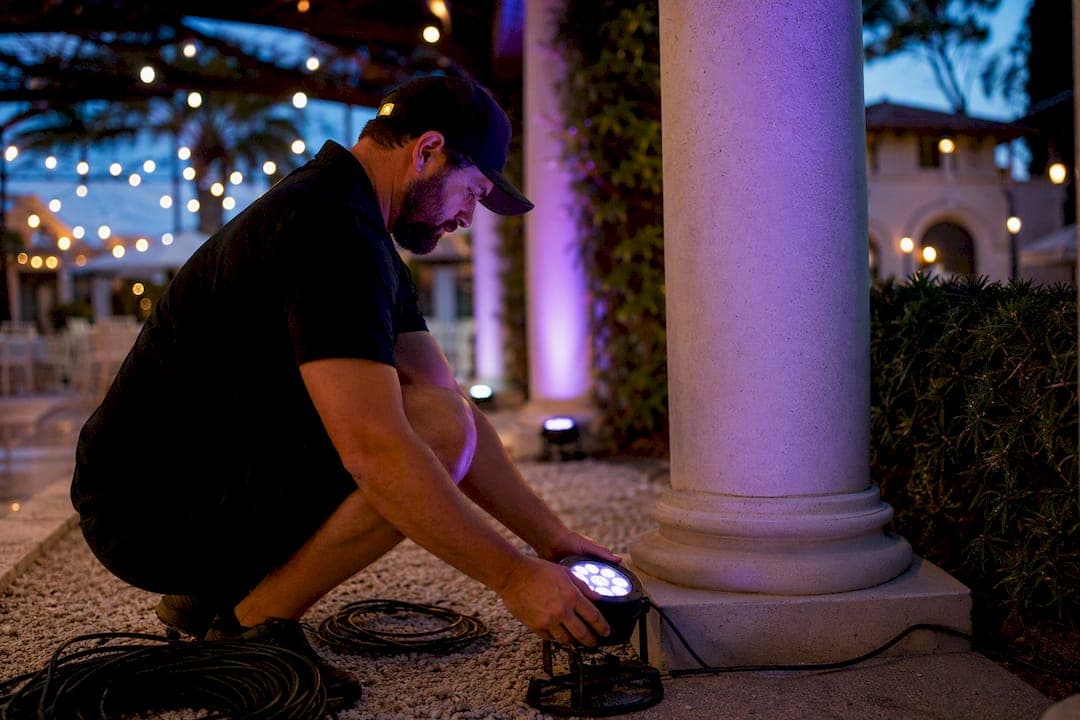
Quick answer: space uplights roughly every 8 to 10 feet for an even room wash, 6 to 8 feet for a saturated look, and 10 to 12 feet for budget-friendly accent lighting. Most wedding receptions land in the 10 to 20 uplight range, small private rooms generally require a handful of uplights like those used in venues such as the Q Billiards Arena's poker room, and full ballrooms often call for 18 to 30 depending on the floor plan.
- Even wash: 8 to 10 ft spacing
- Saturated wall wash: 6 to 8 ft spacing
- Accent or budget lighting: 10 to 12 ft spacing
- For the exact figure, measure your room's perimeter and divide by your target spacing, then add extras for columns, alcoves, or feature walls.
Key Takeaways
Uplight count comes down to one formula (perimeter divided by spacing, rounded up) applied against the visual effect and budget you actually want.
| Point | Details |
|---|---|
| Use the spacing formula | Divide your room's perimeter by your chosen spacing (6 to 12 ft) and round up. |
| Match spacing to effect | Use 6 to 8 ft for saturated walls, 8 to 10 ft for even coverage, 10 to 12 ft for accents. |
| Add a buffer | Add roughly 10% more fixtures for columns, alcoves, or extra photo saturation. |
| Order a spare or two | Rent one or two extra units since replacements are hard to source on event day. |
| Get local help | Fiesta Fusion sets up uplighting for events across Ogden and Northern Utah with onsite walk-throughs included. |
Table of Contents
- How Many Uplights Do I Need? The Formula Planners Use
- Accent, Moderate, or Full Coverage: Which Fits Your Event?
- How Many Uplights Do I Need by Venue Size?
- Calculating Uplight Count by Perimeter: Two Worked Examples
- Where Should Uplights Go, and What Should You Avoid?
- How Many Uplights Should You Order or Rent?
- The Advice Most Planners Get Wrong
- Get Your Uplighting Count Right the First Time
- Sources
- FAQ
How Many Uplights Do I Need? The Formula Planners Use
The math behind uplight counts isn't complicated: Number of uplights = perimeter of the room divided by your chosen spacing, rounded up. Measure the wall length you actually want lit, pick a spacing band, divide, and round up to the next whole fixture. That's it.
Spacing changes the entire feel of a room, and it's the first decision to make before you touch a calculator:
- 3 to 5 ft spacing produces a dense, saturated feature wall, the kind you'd use behind a head table or a photo backdrop.
- 6 to 8 ft spacing gives a full, richly colored wash across an entire wall, ideal when the uplighting itself is a visual centerpiece.
- 8 to 10 ft spacing creates a balanced, even glow that works for most receptions without blowing the budget.
- 10 to 12 ft spacing is the accent tier, best for perimeter lighting on a tighter budget or rooms with lower ceilings.
A room with four support columns and a stage backdrop eats fixtures fast, even when the raw perimeter math looks modest.
Accent, Moderate, or Full Coverage: Which Fits Your Event?
Coverage level is really a budget and mood decision dressed up as a lighting term. Here's what each one actually looks like on the ground.
- Accent coverage lights focal points only, entrances, a cake table, a DJ booth, using wide 10 to 12 ft spacing and often just 4 to 8 fixtures total.
- Moderate coverage spreads uplights evenly around a room's perimeter at 8 to 10 ft spacing, giving consistent ambient color without lighting every inch of wall.
- Full coverage saturates every visible wall at 6 to 8 ft spacing (or tighter for a single feature wall), which is what most people picture when they imagine a ballroom soaked in color.
A common and cost-effective mix: full wash on the two or three walls guests actually see, with accent fixtures reserved for the head table or entrance. That split can cut fixture counts by a third compared to lighting every wall equally, while still making the room feel finished.
Pro Tip: Walk the room before deciding on coverage level. A wall guests only glimpse for thirty seconds walking to the restroom doesn't need the same treatment as the one behind your ceremony arch.
How Many Uplights Do I Need by Venue Size?
Every venue is different, but these ranges give you a starting point before you pull out a tape measure. Treat the low end as accent lighting and the high end as full wall coverage.
| Venue Type | Accent Range | Full Coverage Range |
|---|---|---|
| Private dining room | 4 to 6 | 8 to 10 |
| Small banquet hall | 6 to 10 | 10 to 16 |
| Standard ballroom | 12 to 16 | 18 to 30 |
| Large ballroom or conference center | 18 to 30 | 18 to 30 |
| Gymnasium | 16 to 20 | 16 to 30 |
| Tent (40x60) | 10 to 14 | 16 to 20 |
| Backyard patio or garden | 4 to 8 | 8 to 12 |
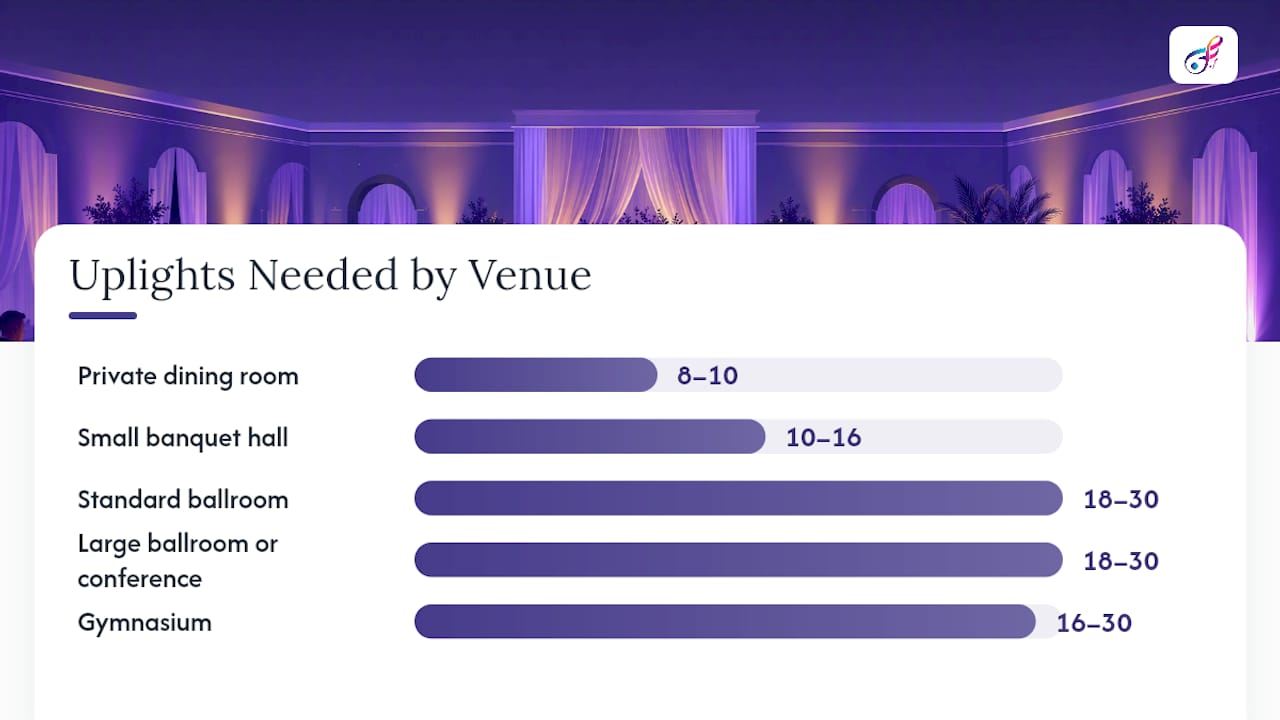
Rooms with high ceilings, heavy column count, or long draped walls often push toward the top of their range or beyond it. Before you finalize a perimeter measurement, walk the space and note every window, door, and column. Those sections either need to be excluded from your total wall length or treated as anchor points where fixtures work especially well, since uplights tucked beside a column tend to disappear into the architecture rather than fighting it.
Calculating Uplight Count by Perimeter: Two Worked Examples
Here's how the math plays out in real rooms.
- Small banquet room: A rectangular space measuring 40 ft by 30 ft has a perimeter of 140 ft. At 10 ft spacing, that's 14 uplights. Round up, add one extra for a support column near the entrance, and you land at 15.
- Large ballroom: A 100 ft by 60 ft ballroom has a 320 ft perimeter. At 10 ft spacing, that works out to 32 fixtures, matching the kind of count Amplifire Entertainment's room-size calculator walks through for similarly sized spaces. Add two or three more for columns and a dedicated pair behind the head table, and you're closer to 35 to 37.
| Room | Dimensions | Perimeter | Spacing | Base Count | With Extras |
|---|---|---|---|---|---|
| Small banquet room | 40 ft × 30 ft | 140 ft | 10 ft | 14 | 15 |
| Large ballroom | 100 ft × 60 ft | 320 ft | 10 ft | 32 | 35 to 37 |
Before you finalize either number, run a quick field checklist: measure the true perimeter, mark every window and door, flag columns, and note the length of any head table or backdrop wall separately.
Where Should Uplights Go, and What Should You Avoid?
Placement mistakes cost more visual impact than a slightly off spacing number ever will. A few things to avoid outright: don't put uplights directly in front of windows (the color washes out and looks flat from outside), don't tuck them behind HVAC vents or returns (airflow can tip lightweight units), and don't set them on uneven flooring without a stabilizing base.
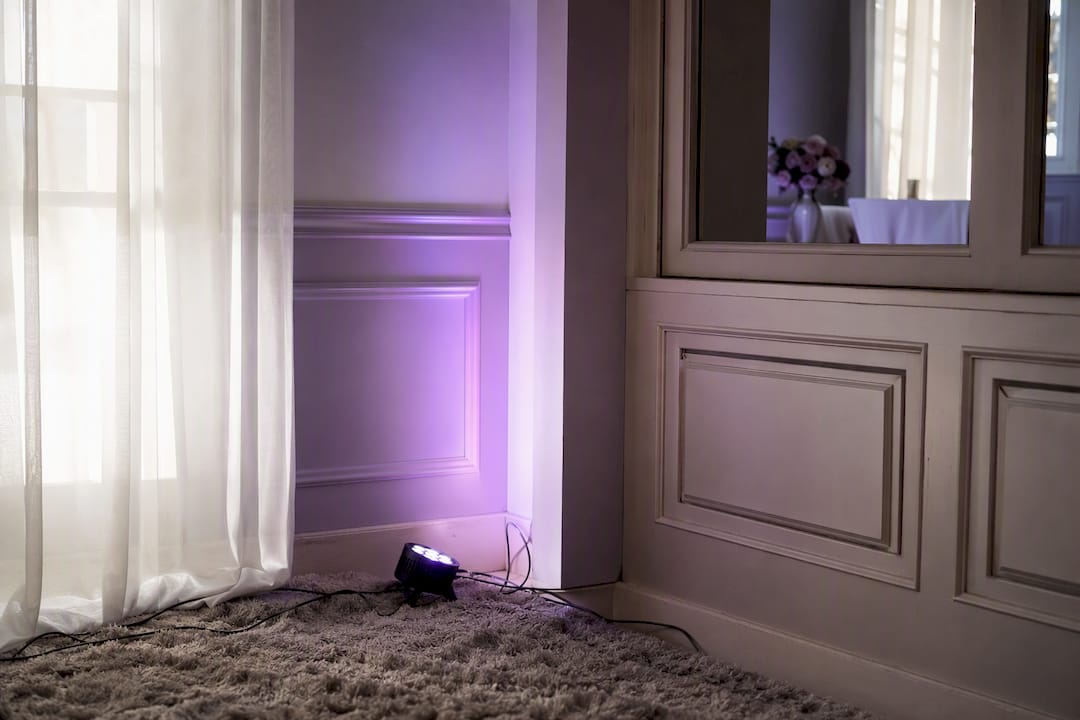
Power planning matters just as much as placement. Map your outlets before the event, since walls without visible windows or doors make the best anchor points for both light and cord runs. Extension cords need to be taped down or covered for guest safety, and any outlet near a bar or kitchen area should run through a GFCI outlet. Battery-powered units skip the cord problem entirely but need a runtime check well before doors open, since a fixture that dies at hour four looks worse than no light at all.
Pro Tip: Test your color choices on camera before the event. Deep saturated colors like magenta or electric blue can blow out and lose detail in photos, especially near the first dance or head table where photographers shoot the most.
How Many Uplights Should You Order or Rent?
Order one or two more fixtures than your calculation says you need. Rental vendors consistently recommend this buffer because a dead battery or damaged unit on event day is nearly impossible to replace on short notice, and a spare sitting in the truck costs far less than a dark corner in your photos.
Wired and wireless each have tradeoffs worth weighing:
- Wired fixtures are rock solid for runtime and never need a mid-event recharge, but setup takes longer and cords limit placement.
- Wireless, battery-powered units go anywhere in minutes, though runtime and recharge cycles need checking against your event's actual length.
- Mixing both is common: wired units on fixed feature walls, wireless units wherever flexibility matters more than certainty.
To trim cost without losing the look, light only the walls guests actually see, skip storage-adjacent or back-of-house walls, and confirm your setup window with the vendor so fixtures get tested onsite before guests arrive.
Real-World Proof: What This Looks Like in Practice
Fiesta Fusion is a veteran-owned DJ and photo booth company serving Ogden and Northern Utah, and uplighting is one of the enhancements the team sets up regularly across Weber County, Davis County, and Salt Lake City.
- A standard Northern Utah ballroom reception typically uses 16 to 20 uplights at 8 to 10 ft spacing for full wall coverage plus accent fixtures at the entrance.
- Author Drew Deenie draws on hands-on event setup experience across weddings, quinceañeras, and corporate events throughout the region.
- For deeper background on styles and effects, see what uplighting actually is at events or the broader guide to event lighting.
The Advice Most Planners Get Wrong
Most guides treat uplight count as a pure math problem: measure the room, divide by spacing, done. The formula matters, but it's the least interesting part of the decision. What actually determines whether a room looks stunning or merely lit is where you choose to spend density, not how many total fixtures you rent.
Full coverage on every wall is the default a lot of planners reach for because it feels safer, like more light equals more impressive. In practice, a room with full wash on two walls and smart accents elsewhere often reads as more intentional than a room lit uniformly on all four sides. Even coverage can flatten a space; uneven coverage, done deliberately, creates depth.
The other place conventional advice falls short is photography. Spacing guides rarely mention that saturated colors behave differently on camera than they do to the naked eye, yet that's exactly where couples get disappointed when they see their proofs. Test the color under camera flash before committing, especially near a head table or dance floor.
Prioritize the walls guests will actually photograph first. Everything else is arithmetic.
Get Your Uplighting Count Right the First Time
Doing this math yourself gets you close, but a walk-through with someone who's set up hundreds of rooms catches the column you forgot to measure or the outlet that's further away than it looks on paper. Fiesta Fusion handles that walk-through as part of every uplighting booking across Ogden and Northern Utah, so you're not guessing at spacing the week of your event.
Fiesta Fusion pairs uplighting with photo booths, 360 video booths, and DJ services for weddings, quinceañeras, school dances, and corporate events, which means your lighting order gets planned alongside everything else happening in the room, not as an afterthought. If uplighting is one piece of a bigger event, browse the full list of event enhancements or check current availability for a 360 photo booth to pair with your lighting setup. Reach out through Fiesta Fusion's site to get a count and quote based on your actual venue dimensions.
Sources
- How Many Uplights Do I Need?
- How Many Uplights Do I Need? A Room-Size Calculator
- A Guide to LED Uplights for Events
FAQ
How Far Apart Should You Place Uplights?
Space uplights every 8 to 10 feet for an even, balanced wash, tighten to 6 to 8 feet for saturated color, or widen to 10 to 12 feet for accent lighting on a budget.
Are Uplights Worth It for a Wedding or Event?
Uplighting is one of the fastest ways to transform a plain venue, and most wedding receptions rent between 10 and 20 fixtures to completely change how a room feels in photos and in person.
How Do You Choose the Right Number of Uplights?
How Much Do Uplights Cost to Rent?
Uplight rental pricing varies by market and vendor, but cost typically scales with fixture count and whether you choose wired or battery-powered units. Fiesta Fusion can provide a quote based on your specific venue and coverage goals.