
TL;DR:
- Well-designed entertainment enhances long-term event memories by triggering emotions, multisensory engagement, and social bonding. Live, interactive, and multisensory elements create stronger emotional peaks and shared moments that the brain encodes more vividly. Investing in well-structured entertainment and deliberate transitions ensures memorable experiences that attendees actively recall and share.
Well-designed entertainment is the single most reliable tool you have for creating lasting event memories. It works because it triggers emotional arousal, multisensory encoding, and collective experience simultaneously, and those three forces are exactly what the brain uses to convert short-term experience into long-term recall.
The core mechanisms at work:
- Emotional arousal floods the brain with neurotransmitters that strengthen memory encoding. Positive, high-arousal moments are recalled more vividly and more accurately than neutral ones.
- Multisensory engagement gives the brain multiple retrieval pathways. A guest who heard a song, felt the bass, and saw the lights change has three separate cues that can trigger the memory later.
- Collective effervescence, the shared emotional surge that happens when a crowd moves or reacts together, creates social memory that attendees reinforce every time they talk about the event afterward.
- The peak-end rule means attendees judge the entire event by its most intense moment and its final impression, not by the average of everything that happened.
For planning, the immediate implication is this: prioritize live, interactive, and multisensory entertainment elements that are timed to create a deliberate peak and a strong close. Atmosphere and shared energy outlast any individual performer's name in long-term memory.
Table of Contents
- How does entertainment influence event memories?
- What types of entertainment work best for different events?
- How do you match entertainment to your event's specific goals?
- What design tactics actually convert entertainment into lasting memories?
- What should you budget and when should you book entertainment?
- How do you make hybrid and virtual audiences feel part of the experience?
- How do you evaluate and choose the right entertainment vendor?
- What does the research actually say about entertainment and memory?
- Key Takeaways
- What planners often get wrong about entertainment
- Fiesta Fusion can help you build events worth remembering
- FAQ
How does entertainment influence event memories?
Entertainment shapes memory through biology as much as experience design. Music and live social interaction trigger dopamine and oxytocin release, two neurochemicals that act as biological bookmarks, tagging a moment as worth keeping. When a crowd erupts during a live performance, the brain does not just record the sound. It records the emotion, the social context, and the physical sensation together, which is why music and autobiographical memory are so tightly linked in neuroscience research.
The peak-end rule has direct business consequences. An attendee who experienced one genuinely thrilling moment and a satisfying close will rate the entire event higher than someone who sat through a competent but flat program. That rating drives word-of-mouth, social sharing, and the likelihood they attend your next event.
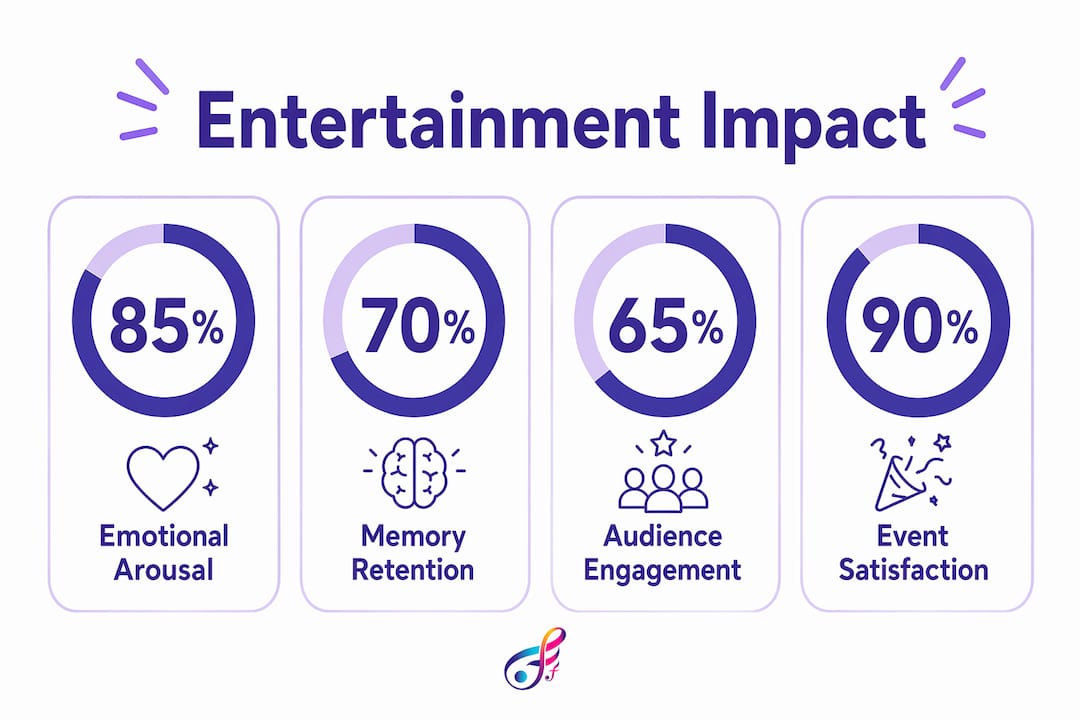
Live performances produce significantly higher subjective pleasure and physiological emotional arousal than identical recorded versions, even under controlled viewing conditions, with measurable increases in skin conductance responses. That gap between live and recorded is the core argument for investing in live entertainment rather than relying on video playback or pre-recorded sets.
Consider a corporate product launch that ends with a live band playing the brand's campaign song as the product appears on stage. Attendees share the clip. They talk about it at dinner. Three months later, they associate the product with that feeling. That is not an accident of good taste. It is the peak-end rule and collective effervescence working together.
What types of entertainment work best for different events?
The right format depends on what memory effect you are trying to create and where in the program you need it.
Live music is the highest-impact choice for creating collective effervescence. Multiple studies show that features of live music, including parasocial bonds with performers, immersion, and attending with others, predict both enjoyment during the event and lasting wellbeing up to a week afterward. Use it for peak moments: the first dance, the product reveal, the gala opener.
DJs deliver continuous energy management across a full program. A skilled DJ reads the room and adjusts tempo, genre, and volume in real time, which keeps arousal levels elevated without the fatigue that comes from a single sustained peak. They are the right choice when you need sustained engagement across two or more hours.
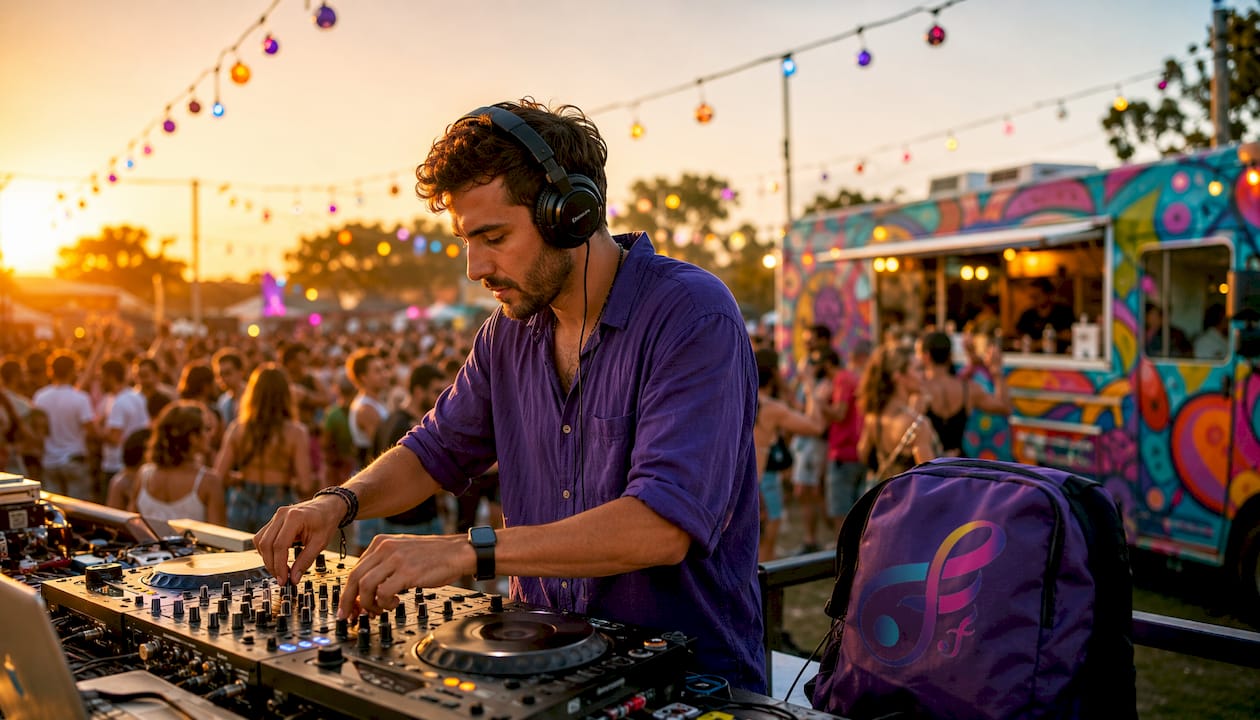
Interactive acts (improv comedy, mentalists, caricaturists, photo booths, 360 video booths) create social bonding through participation. Attendees who do something together remember it differently than attendees who watched the same thing. Synchronized activities like dancing can increase trust and cooperative intent, which is particularly useful at B2B networking events.
Speakers and hosts/emcees provide narrative framing. They tell attendees what they just experienced and what it means, which helps consolidate memory. A strong emcee is not decoration. The role of an emcee is to manage emotional pacing and give the audience a coherent story to carry home.
Photo booths and 360 video booths serve a specific function: they create mediated memories. Attendees who capture a moment during an event are not just documenting it. They are creating a future retrieval cue. That photo or video becomes the trigger that brings the whole emotional experience back months later.
Immersive and virtual experiences work best for conferences and hybrid events where you need remote participants to feel present. They require more technical investment but can produce strong novelty effects.
Short use-case examples by event type:
- Wedding reception: Live band for the first dance and peak moments; DJ for the dance floor; photo booth for mediated memory creation.
- Corporate conference: Keynote speaker for narrative framing; interactive breakout acts for social bonding; live music for the gala dinner.
- Product launch: Theatrical reveal with live music and dramatic lighting; interactive demo stations for tactile engagement.
- Festival: High-energy main stage programming for collective euphoria; art installations and interactive zones for discovery and dwell time.
- Hybrid event: Live host with dedicated remote interaction segments; synchronized cues that both audiences experience simultaneously.
How do you match entertainment to your event's specific goals?
The most common planning mistake is choosing entertainment based on what sounds impressive rather than what serves the event's objective. A celebrity DJ at a leadership retreat may generate buzz but undermine the intimate trust-building the event was designed to create.
Map your objective first, then select the format:
Networking and relationship-building: Prioritize interactive acts and synchronized activities. Shared participation lowers social barriers faster than passive watching. Place this entertainment early in the program, before formal networking sessions, so attendees arrive at those conversations already warmed up.
Product launch or brand awareness: Design a single theatrical peak using live music, dramatic lighting, and a reveal sequence. Time it as the emotional high point of the evening, not the opener. Let anticipation build.
Celebration (weddings, galas, milestones): Layer live music with sensory enhancements: uplighting, scent, specialty food and drink moments. The goal is collective joy, and every sensory channel you activate adds another memory retrieval path.
Learning and retention (conferences): Use entertainment as a reset between content blocks, not as a reward at the end. A five-minute interactive moment after a dense session restores attention and helps attendees consolidate what they just heard.
Hybrid programs: Design every entertainment moment with two audiences in mind. If the in-room experience cannot be translated to a screen, it creates a two-tier event where remote attendees feel excluded, which is the opposite of collective effervescence.
For weddings specifically, the entertainment choices that matter most are the ones that create shared moments across all guests, not just the couple. A wedding entertainment plan that accounts for age range, cultural background, and energy arc across the full reception will outperform a plan built around a single impressive act.
What design tactics actually convert entertainment into lasting memories?
The act itself is only part of the equation. How you structure the moment around the act determines whether it becomes a peak or just another thing that happened.
Pro Tip: Rehearse your transitions as carefully as the entertainment itself. Poor transitions erase emotional momentum. If the lights come up awkwardly after a peak moment, or the audio cuts out between acts, the brain registers the disruption and the memory of the peak weakens.
Here is a practical design sequence planners can run through during a final walk-through:
- Identify your peak moment. One moment per event, not three. Trying to create multiple peaks dilutes all of them.
- Build anticipation before it. Lower the energy slightly in the 10 minutes before the peak. The contrast amplifies the impact.
- Layer the senses at the peak. Combine audio, lighting change, and a tactile or taste element if possible. Each additional sense adds a retrieval pathway.
- Use controlled surprise. An element attendees did not expect, a flash performance, a sudden lighting shift, a guest appearance, spikes attention and produces more vivid memory encoding.
- Design the ending deliberately. The peak-end rule means your closing moment carries as much weight as the peak. Do not let the event fade out. End on something intentional: a final song, a toast, a visual moment.
- Create a social sharing hook. A photo booth, a 360 video station, or a branded backdrop gives attendees a way to capture and share the peak, extending the memory socially and temporally.
Mediated memory research shows that live media practices create two distinct modes: "live as future memory," where attendees capture moments anticipating how they will feel looking back, and "experiential live," where they are fully present. Design for both by giving attendees a designated capture moment rather than letting phones compete with the experience throughout.
What should you budget and when should you book entertainment?
Lead time is not just a logistics issue. It directly affects memory quality because rehearsal time determines how clean your transitions are, and clean transitions protect your peak moments.
| Entertainment type | Recommended lead time | Cost shape |
|---|---|---|
| Live band (4–6 piece) | 6 months | Higher fixed cost; strongest peak effect |
| DJ (professional) | 3–6 months | Mid-range; best value for sustained energy |
| Interactive acts (photo booth, 360 booth) | 4 weeks | Moderate; high ROI on mediated memory |
| Keynote speaker / host | 3–9 months | Variable; wide range by profile |
| Immersive / theatrical production | 6 months | Highest cost; requires venue coordination |
Where budget delivers the biggest memory return: audio quality and staging come before performer fame. Attendees remember atmosphere, energy, and social connection more reliably than specific performer names. A well-mixed room with great lighting and a skilled DJ will outperform a recognizable name playing through a poor sound system.
Logistics items that directly affect audience experience and memory outcome:
- Sightlines: every attendee should have a clear view of the peak moment
- Audio balance: uneven sound coverage creates a two-tier experience within the same room
- Cueing: entertainment cues should be rehearsed with the production team, not improvised
- Transitions: dead air between acts is the fastest way to lose emotional momentum
- Contingency: have a backup plan for technical failures that can execute within 90 seconds
For a full logistics and timeline framework, the event planning step-by-step guide covers sequencing from venue confirmation through day-of execution.
How do you make hybrid and virtual audiences feel part of the experience?
Remote attendees are the hardest audience to create memories for, because the screen filters out most of the sensory and social cues that drive memory encoding. The goal is not to replicate the in-room experience. It is to create shared moments that work on a screen.
Technical checklist for hybrid entertainment:
- Multi-feed audio with a dedicated mix for the stream, separate from the room mix
- Camera choreography planned in advance, not reactive, so remote viewers see what matters
- Latency management: keep the stream delay under 10 seconds to allow real-time interaction
- Dedicated remote interaction moments built into the run sheet, not added as an afterthought
Design tactics for shared moments across both audiences:
- Synchronized cues: A countdown, a lighting change, or a musical drop that both in-room and remote audiences experience at the same moment creates a brief but genuine shared peak.
- Remote participant callouts: Name remote attendees on screen or in the room. Being seen by the in-person crowd creates a social connection that passive viewing cannot.
- Distributed interactivity: Polling, live Q&A, and real-time reaction tools give remote attendees agency. Participation encodes memory more strongly than observation.
- Capture and share hooks: Photo booths and 360 video stations serve in-room attendees, but the content they generate can be shared instantly with remote participants, creating a mediated memory bridge.
One important caveat: research suggests that frequent screen viewing habits may reduce emotional sensitivity to live performances. Remote audiences who watch events on screens regularly may need stronger interactive stimuli to reach the same arousal level as in-room attendees. This is the strongest argument for building dedicated interaction moments into hybrid programs rather than treating remote attendance as a passive broadcast.
Recorded content is the weakest option. It removes the live element that drives emotional arousal and eliminates the social synchrony that creates collective effervescence. Use live interaction wherever possible, even for small remote audiences.
How do you evaluate and choose the right entertainment vendor?
The evaluation criteria that matter for memory impact are different from the ones that matter for logistics alone. A vendor who is easy to book and shows up on time is necessary but not sufficient.
Evaluation criteria ranked by memory impact:
- Alignment to objective: Can the vendor articulate how their performance creates the specific emotional effect your event needs?
- Experience with similar audiences: A performer who has worked your audience type knows how to read the room and adjust in real time.
- Technical rider clarity: Vague technical requirements are a sign of poor rehearsal discipline. Clean riders mean clean transitions.
- Ability to create shareable peaks: Does the vendor build moments designed for social capture, or do they perform and leave?
- Reliability and contingency planning: What happens if a key element fails? The answer tells you how seriously they take your event.
Live-readiness checklist before signing:
- Rehearsal plan confirmed with venue and production team
- Contingency for equipment failure documented
- Interactive elements specified in the contract, not just implied
- Transition cues agreed with the emcee or program director
- Post-event feedback mechanism in place
Sample vendor questions that reveal memory-focused execution:
- "Describe a previous event where you created a peak moment. What specifically did you do, and how did you know it worked?"
- "How do you adjust your performance if the room energy is lower than expected?"
- "What do you need from us in terms of rehearsal time and technical setup to deliver your best work?"
- "How do you handle transitions between your set and the next program element?"
What does the research actually say about entertainment and memory?
The experimental evidence is clearer than most planners realize, and it makes a strong case for live, interactive entertainment over recorded or passive formats.
Live performances produce significantly higher subjective pleasure and physiological emotional arousal than identical recorded versions, measured through both self-report and skin conductance responses. This is not a preference finding. It is a biological one. The live context activates arousal pathways that recorded content does not, which means the memory encoding is stronger from the start.
Festivalization research confirms that bringing festival-style elements, diverse entertainment, interactive zones, and high energy, into business events increases perceived value, engagement, and positive word-of-mouth. The effect is stronger for in-person formats, which reinforces the case for live over virtual when budget allows.
The collective effervescence research across multiple studies (N = 789) shows that live music predicts both immediate enjoyment and lasting wellbeing up to a week after the event. The mechanism is social: shared attention to music creates a plural experience that individual listening cannot replicate.
For measurement, traditional post-event surveys often miss the most important data because they ask about satisfaction rather than memory. More useful metrics include: prompted recall of specific moments (which moments do attendees describe unprompted?), social sharing volume and content (what did they capture and post?), and net promoter score tied specifically to the entertainment experience. Biometric data, heart rate variability and skin conductance during key moments, is available through wearable event tech and gives real-time arousal data that correlates directly with memory encoding strength.
Key Takeaways
Entertainment that creates emotional peaks, multisensory cues, and shared moments is the most reliable driver of long-term event memory, and the research supports investing in live, interactive formats over passive or recorded alternatives.
| Point | Details |
|---|---|
| Live beats recorded | Live performances produce higher physiological arousal and stronger memory encoding than identical recorded versions. |
| Design one clear peak | One deliberate, high-intensity moment outperforms three moderate ones; use contrast and sensory layering to amplify it. |
| Collective experience extends memory | Shared emotional moments are reinforced every time attendees retell them, extending memory socially and temporally. |
| Book early, rehearse transitions | Lead times of 3 months protect rehearsal quality; clean transitions preserve emotional momentum at the peak. |
| Fiesta Fusion for Northern Utah events | Fiesta Fusion provides DJ, photo booth, 360 video booth, and uplighting services designed to create peak moments and mediated memories. |
What planners often get wrong about entertainment
The conventional wisdom in event planning treats entertainment as a reward, something you add at the end once the "real" program is done. That framing gets the psychology exactly backward.
Entertainment is not the dessert. It is the structure around which memory forms. The keynote, the networking session, the product demo: those are the content. Entertainment is the emotional architecture that determines whether any of that content gets remembered. A conference that runs a brilliant speaker into a dead room with flat lighting and no musical transition will be forgotten faster than a mediocre speaker who walks into a room that is already alive.
The other mistake is chasing performer fame over atmosphere quality. Attendees store the energy of the room, the feeling of being in a crowd that was genuinely excited, far more reliably than they store who was on stage. A well-curated DJ set in a room with great sound and lighting will generate stronger post-event recall than a recognizable name playing through a mediocre system. The corporate entertainment ideas that consistently outperform are the ones built around atmosphere and interaction, not celebrity.
What I find most undervalued is the ending. Planners spend enormous energy on the opening and the peak, then let events drift to a close. The peak-end rule is unforgiving on this point. A strong peak followed by a weak ending produces a weaker overall memory than a slightly lower peak with a deliberate, satisfying close. Design your final five minutes with the same intentionality you give your headline act.
Fiesta Fusion can help you build events worth remembering
If you are planning an event in Northern Utah and want entertainment that actually creates the peaks and shared moments this article describes, Fiesta Fusion is built for exactly that. As a veteran-owned DJ and photo booth company serving Ogden, Weber County, Davis County, and Salt Lake City, Fiesta Fusion provides professional wedding DJs, corporate event DJs, 360 video booth rentals, photo booths, uplighting, and event enhancements, all the elements that layer senses, create mediated memories, and keep a room energized from first song to final moment.
The 360 video booth is particularly effective for creating the shareable peak moments that extend event memory beyond the night itself. Guests capture the moment, share it, and every share is a retrieval cue that brings the experience back. Book early: DJ and booth availability in Northern Utah fills 3–6 months out for peak season dates. Visit Fiesta Fusion to check availability or get a quote for your next event.
FAQ
What is the role of entertainment in event memories?
Entertainment creates the emotional peaks, multisensory cues, and shared social moments that the brain uses to encode long-term memories. Without a deliberate entertainment structure, most event content fades within days.
How can you make your event more memorable?
Design one high-intensity peak moment using live entertainment, layer multiple senses at that moment, and close the event deliberately. The peak-end rule means those two points carry more weight than everything in between.
Why does live entertainment matter more than recorded formats?
Live performances produce measurably higher physiological arousal and subjective pleasure than identical recorded versions, which means the memory encoding is stronger. The social synchrony of a shared live moment also creates collective effervescence that recorded content cannot replicate.
What role does entertainment play in wedding memories?
Entertainment drives the emotional arc of a wedding reception, from the energy of the first dance to the final song of the night. The moments guests remember and retell are almost always the shared, high-energy peaks created by live music, a DJ, or interactive elements like a photo booth.
How do you measure entertainment's impact on attendee engagement?
Use prompted recall (which moments do attendees describe unprompted in post-event surveys?), social sharing volume and content, and net promoter scores tied specifically to the entertainment experience. Biometric tools that measure heart rate and skin conductance during key moments give real-time arousal data that correlates directly with memory strength.