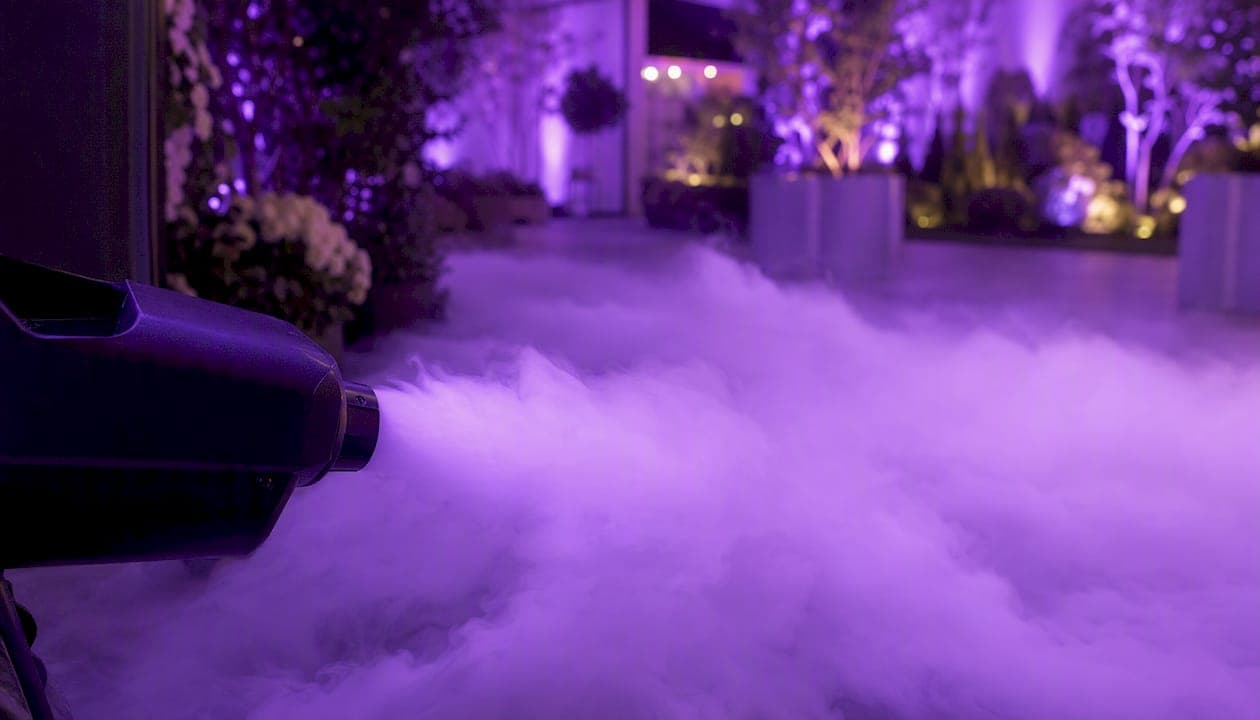
A fog machine is a special-effects device that vaporizes a water-based glycol or glycerin fluid into a visible aerosol, giving event planners a fast, controllable way to add drama, depth, and atmosphere to any moment. Here is what you need to know before booking one:
- Core use cases: Grand entrances, wedding first dances, dance-floor energy, photo backdrops, and themed environments
- Key control method: DMX integration for synchronized cues with lighting and music
- Safety non-negotiable: Always verify venue policy and smoke-alarm type before the event
- Bottom line: Fog is an atmosphere tool that works with your lighting and sound design, not instead of it
Fiesta Fusion regularly coordinates fog effects alongside uplighting and photo booths for events across Northern Utah, so the guidance below reflects real-world planner decisions, not just spec sheets.
Key Takeaways
A fog machine vaporizes water-based glycol or glycerin fluid into a visible aerosol, and matching the effect type to the venue and moment is what separates a memorable event from a fire alarm.
| Point | Details |
|---|---|
| Core definition | A fog machine vaporizes glycol or glycerin fluid in a heat exchanger to produce a visible aerosol. |
| Match effect to moment | Use low-lying fog for first dances, haze for lighting enhancement, standard fog for dance floors. |
| Standard fog hang time | Standard fog typically clears in under two minutes in a ventilated space; haze lasts significantly longer. |
| Always check venue policy | Confirm smoke detector type, venue rules, and MSDS availability before every event. |
| Fiesta Fusion integration | Fiesta Fusion coordinates DMX fog cues with uplighting and photo booths for events across Northern Utah. |
Table of Contents
- What is a fog machine at events, and how does it work?
- What types of fog effects should you know about?
- Why do event planners use fog machines?
- How long does fog last, and what affects it?
- What are the safety and health considerations for fog fluids?
- How do controls and DMX integration work?
- Venue and safety checklist before you use fog
- How do you choose the right fog effect for your event?
- Quick setup checklist and troubleshooting
- How Fiesta Fusion integrates fog into a pro event workflow
- When to use fog sparingly, and when to lean in
- Fiesta Fusion handles fog, lighting, and photo moments end to end
- Sources
- FAQ
What is a fog machine at events, and how does it work?
According to Wikipedia's fog machine entry, a fog machine produces visible vapor by vaporizing water-based glycol or glycerin fluid in a heated metal heat exchanger. The vapor exits the nozzle and condenses into an opaque aerosol when it meets cooler room air. That aerosol is what you see as fog.
The process in plain terms: fluid from a tank gets pumped into a heat exchanger, heated to vaporization, then pushed out through a nozzle or fan. The whole cycle takes several minutes on first warm-up, then a shorter reheat window between bursts.
| Component | What it does | What to ask your vendor |
|---|---|---|
| Fluid tank | Holds glycol or glycerin solution | Capacity in quarts; refill access during event |
| Heat exchanger | Vaporizes the fluid | Wattage rating; continuous vs. intermittent duty |
| Pump | Moves fluid to the exchanger | Output rate (mL/min or CFM) |
| Nozzle or fan | Directs vapor into the room | Adjustable direction; fan-assisted spread |
| Control input | Triggers output | DMX channel, wired remote, or wireless remote |
Professional machines rated for continuous operation avoid the reheat pauses that consumer units need, which matters when you have back-to-back entrance cues.
Pro Tip: During load-in, run a full test burst with the venue's HVAC system at event settings. What looks perfect in an empty room can vanish in 20 seconds once the air handlers kick on at full capacity.
What types of fog effects should you know about?
Not all fog is the same, and choosing the wrong type for a moment is one of the most common planner mistakes.
Standard fog rises and disperses through the room. It is the most common type, best for dance floors and DJ drops. Output is dense but hang time is often under two minutes in a ventilated space.
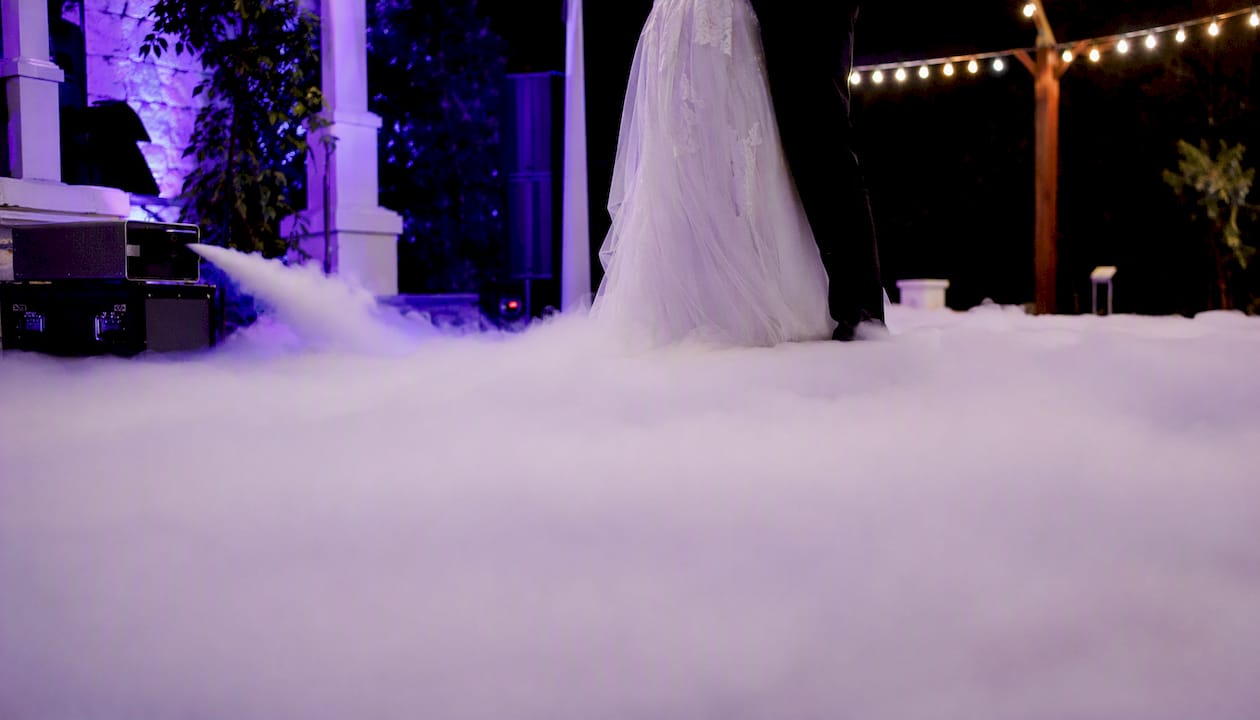
Low-lying fog stays close to the ground using a chiller attachment or dry-ice method. This effect is high-impact for wedding first dances and themed entrances but requires cooling equipment, careful dry-ice handling, and sometimes advance venue approval.
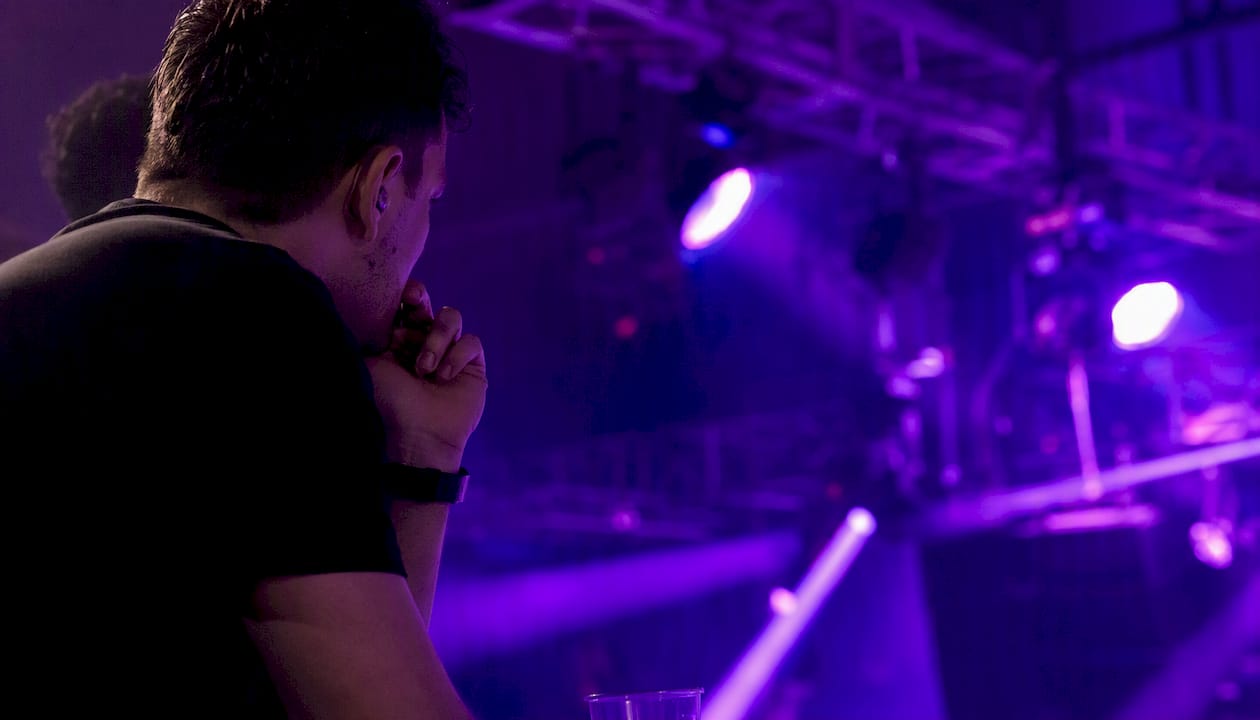
Haze is a fine mist, often mineral oil or water-based, designed to linger and make lighting beams visible without obscuring sightlines. Haze machines vaporize fluid to produce a finer, longer-hanging mist used primarily to enhance lighting. Think concert lighting rigs and theatrical productions.
CO2 burst effects use compressed CO2 for a fast, cold, dramatic burst. They dissipate quickly and are popular for DJ drops and confetti cannons.
| Effect type | Best for | Persistence | Indoor safety | Setup complexity | Typical cost range |
|---|---|---|---|---|---|
| Standard fog | Dance floors, DJ drops | Under 2 minutes | Moderate; check alarms | Low | Low |
| Low-lying fog | First dances, entrances | 1–3 minutes at ground | Moderate; needs clearance | Medium to high | Medium |
| Haze | Lighting enhancement | Long (5–15 minutes) | Generally good; use water-based fluid | Low to medium | Medium |
| CO2 burst | Dramatic drops, reveals | Very short (seconds) | High; no residue | Medium | Medium to high |
Questions to ask your vendor for each type:
- Low-lying: Does the chiller unit require a separate power circuit?
- Haze: Is the fluid water-based or mineral oil, and does the venue allow mineral oil?
- CO2: What is the tank refill plan for multi-hour events?
Why do event planners use fog machines?
Fog adds value in specific, measurable ways. The most practical benefits:
- Lighting enhancement: Fog and haze make laser beams and uplighting columns visible, turning a good lighting rig into a great one. See how lighting design at parties pairs with atmospheric effects.
- Photo depth: A light layer of haze gives photos a cinematic quality and softens harsh backgrounds behind subjects.
- Entrance drama: A timed fog burst at a grand entrance or cake reveal creates a moment guests remember.
- Theme immersion: Halloween events, haunted attractions, and theatrical productions rely on fog to sell the environment.
- Dance-floor energy: DJ drops paired with a fog burst raise the energy in a room faster than almost any other effect.
Common event types where fog adds clear value:
- Wedding first dances (low-lying fog)
- DJ sets and school dances (standard fog or CO2 bursts)
- Corporate product reveals (haze or standard fog with lighting)
- Theatrical productions and scene transitions (haze)
- Halloween and haunted attractions (standard fog, heavy output)
- Photo booth backdrops (light haze or standard fog for texture)
When fog is overused, it becomes a distraction. A small room filled with continuous fog output obscures faces, triggers alarms, and frustrates guests. Match the effect to the moment.
How long does fog last, and what affects it?
Hang time depends on several variables working together:
- Room volume: Larger rooms dilute fog faster; smaller rooms accumulate it quickly
- HVAC airflow: Active air handlers are the single biggest enemy of fog persistence
- Particle size: Haze particles are finer and stay suspended longer than standard fog droplets
- Output volume: Higher wattage machines push more fluid per burst, extending visible density
- Machine placement: Low placement near the floor extends low-lying effects; elevated placement disperses fog faster
Standard fog typically clears quickly in ventilated spaces. Haze can persist for 5–15 minutes depending on airflow. For fluid quantity planning, machine wattage drives consumption rate; a higher-wattage machine burns through fluid faster per burst, so plan fluid quantity by wattage and expected cue frequency and always bring a backup quart.
Pro Tip: Run your fog test with the venue's HVAC at the same setting it will be during the event, not turned off. The difference in hang time can be dramatic enough to change your entire cue plan.
What are the safety and health considerations for fog fluids?
Most indoor-safe fog machines use water-based glycol or glycerin solutions. These are the standard for venues, schools, and wedding halls. Oil-based fluids exist but are generally not recommended for enclosed indoor events because residue can coat floors and surfaces.
Dry-ice and CO2 methods introduce different considerations: dry ice requires handling precautions and CO2 tanks need proper storage and ventilation.
Safety items to verify before every event:
- MSDS availability: Request the Material Safety Data Sheet from your rental vendor for the specific fluid being used
- Manufacturer warnings: Some fluids are not rated for use near food service or with certain HVAC systems
- Venue smoke alarm type: Ionization detectors are far more sensitive to fog particles than photoelectric detectors; confirm which type is installed
- Guest sensitivities: Guests with asthma, respiratory conditions, or animal companions may react to glycol aerosols
- ADA considerations: Heavy fog near exits or pathways can reduce visibility for guests with mobility or vision needs
Always request the MSDS from your rental vendor before the event, not on the day of load-in. Venues and fire marshals may require it for approval, and knowing the fluid composition lets you make an informed call about guest safety and alarm risk.
Practical mitigations: run limited timed bursts rather than continuous output, keep a fresh-air purge plan ready, post brief signage at entry points for guests with sensitivities, and brief your on-site staff on the cue schedule so no one is caught off guard.
How do controls and DMX integration work?
Control options range from simple to fully integrated:
- On-machine switch: Basic on/off; no timing precision
- Wired remote: Allows operator to trigger bursts from a distance
- Wireless remote: More flexibility for positioning; useful for solo operators
- DMX integration: Connects the fog machine to your lighting console so fog cues fire in sync with lighting changes and music drops
Key specs to ask about: wattage (determines output volume), output rate in CFM or mL/min, warm-up time (first heat), reheat time (between bursts), and duty cycle (how long it can run before needing a rest).
For run-of-show notes, list each fog cue with a timestamp, the triggering event (song drop, entrance announcement), the expected duration of the burst, and the operator's position. DMX-integrated rigs let your lighting tech handle fog cues from the same console, which removes one more variable from the live event.
Pro Tip: If your lighting tech is running DMX, ask them to assign fog to a dedicated channel and label it clearly in the cue list. A misfired fog burst during a quiet speech is the kind of thing that ends up in the wrong kind of event recap.
Venue and safety checklist before you use fog
Run through this before every event:
- Confirm the venue's written policy on fog and haze machines
- Identify the smoke detector type (ionization vs. photoelectric) and location
- Notify venue operations staff and, if required, the local fire marshal
- Verify egress paths remain visible at your planned fog density
- Add fog machine usage, fluid type, and MSDS to your vendor contract
- Brief all on-site staff on the cue schedule and emergency shutoff location
- Post signage at entry points noting atmospheric effects in use
- Confirm no guests with severe respiratory conditions are seated near fog zones
Red flags that should stop you: an explicit venue ban, ionization detectors you cannot disable or cover, or a guest list that includes individuals with documented respiratory conditions who have not been consulted.
How do you choose the right fog effect for your event?
Work through these decision factors in order:
- Venue scale: Large halls and outdoor stages handle heavy fog output; small rooms need restraint
- Indoor vs. outdoor: Outdoor events need high-output machines since fog disperses quickly; haze is rarely effective outdoors
- Primary goal: Photography and lighting enhancement point toward haze; dramatic moments point toward standard fog or low-lying effects
- Safety constraints: Venue alarm type and guest sensitivities may eliminate certain options before you start
- Budget: Entry-level consumer machines work for small parties with simple cues; professional DMX-integrated rigs are worth the rental cost for weddings and corporate events where timing precision matters
Budget framing:
- Low: Consumer-grade fog machine rental, basic wireless remote, standard glycol fluid
- Medium: Professional machine with wired DMX, chiller attachment for low-lying effects, operator on standby
- High: Full DMX rig integrated with lighting console, CO2 burst system, dedicated operator, venue clearance support included
Vendor questions to finalize your selection:
- What is the machine's continuous duty rating?
- Is the fluid water-based and MSDS-available?
- Can it be DMX-controlled from our lighting console?
- What is the reheat time between bursts?
Quick setup checklist and troubleshooting
Setup checklist for load-in:
- Place machine at the correct height and angle for the desired effect
- Secure power connection on a dedicated circuit if possible
- Fill fluid tank and confirm fluid type matches venue approval
- Run warm-up cycle and confirm output before guests arrive
- Test cues with lighting and HVAC running at event settings
- Station an operator or designate a staff member for the shutoff
| Symptom | Likely cause | Fix |
|---|---|---|
| Weak or thin output | Low fluid, insufficient warm-up | Refill tank; allow full warm-up cycle |
| Machine not producing fog | Overheated; needs reheat pause | Wait for reheat; check duty cycle rating |
| Smoke alarm triggered | Wrong detector type or too much output | Reduce burst duration; notify venue ops immediately |
| Fog dissipates instantly | HVAC airflow too high | Reposition machine; reduce HVAC fan speed if possible |
| Uneven spread | Poor placement or no fan assist | Reposition; use fan-assisted nozzle or add a secondary unit |
How Fiesta Fusion integrates fog into a pro event workflow
A replicable workflow for planners coordinating fog with entertainment:
- Pre-event site survey: Walk the venue, note HVAC vent locations, detector types, and power outlet positions
- HVAC test: Run the fog machine with HVAC at event settings to measure real hang time
- Cue design: Map each fog moment to a song cue or announcement in the run-of-show; assign DMX channel if applicable
- Timed runs: Program entrance bursts, dance-floor drops, and photo-op windows with specific durations
- Post-event purge: Run the machine on clean fluid or water for 30 seconds to clear residue from the heat exchanger
Contract items to include: fluid type and brand, MSDS document attached, machine model and wattage, operator name and responsibilities, venue approval confirmation, and shutoff protocol.
Pro Tip: Include a "fog cue sheet" as an exhibit to your vendor contract. It forces everyone to agree on timing before the event, and it gives the venue a record that fog use was planned and approved.
When to use fog sparingly, and when to lean in
The conventional wisdom is that more fog equals more drama. That is wrong about half the time.
Small rooms with low ceilings and ionization detectors are genuinely bad environments for standard fog. One long burst can fill the space, reduce visibility, and trip an alarm before the song even drops. In those rooms, a light haze pass or no effect at all is the smarter call. Guests notice a well-timed entrance more than they notice fog that is just... there.
Large concert halls, outdoor festival stages, and theatrical productions are where you lean in. The room absorbs the effect, lighting rigs have the height to make haze beams dramatic, and the audience expects spectacle. A single well-timed fog burst at a headliner's drop in a 2,000-person venue lands harder than anything you can do with confetti.
The rule of thumb: match the effect to the moment and the venue, not to your enthusiasm for the gear. A first dance with low-lying fog is memorable because it is precise. A reception hall full of continuous fog for three hours is just a fire hazard with a playlist.
Fiesta Fusion handles fog, lighting, and photo moments end to end
Planning fog effects alongside lighting and photo booths is where coordination gets complicated fast. Fiesta Fusion, a veteran-owned entertainment company serving Ogden and Northern Utah, handles atmospheric effects as part of a fully integrated event package. That means DMX-integrated fog cues coordinated with uplighting, operator on-site for the full event, MSDS documentation ready for venue approval, and fog timing built directly into the run-of-show alongside DJ cues.
Add a 360 photo booth to your package and fog effects become part of the photo experience, not just the dance floor. Fiesta Fusion serves Weber County, Davis County, and Salt Lake City. Request a quote and get a package built around your venue, your moments, and your guests.
Sources
- Fog machine - Wikipedia
- Fog and Haze Machines - Enhance Your Event | Eventech
- The Ultimate Guide to Fog and Haze on Stage - EVERYTHING BACKSTAGE
- How a fog machine works - Rosco Spectrum
- Top 5 Reasons to Get a Fog Machine for Your Next Big Event Video - Seiko Giken (blog)
FAQ
Why do they use fog machines at concerts?
Fog and haze make lighting beams, lasers, and moving heads visible from the audience. Without atmospheric particles in the air, most concert lighting effects are invisible except at the point they hit a surface.
What is the point of a fog machine at an event?
A fog machine adds visual depth, enhances lighting, and creates dramatic moments for entrances, reveals, and dance floors. It is an atmosphere tool that amplifies what your lighting and sound design are already doing.
How long does fog last from a fog machine?
Standard fog typically clears in under two minutes in a ventilated space. Haze, which produces finer particles, can persist for 5–15 minutes depending on room airflow and HVAC settings.
What liquid is used in fog machines?
Most indoor fog machines use a water-based glycol or glycerin solution. Oil-based fluids exist but are generally avoided for enclosed indoor events due to residue and safety concerns.
Can fog machines set off smoke alarms?
Yes, particularly ionization-type detectors, which are sensitive to the fine particles fog produces. Always confirm the detector type with your venue and run a test before guests arrive.