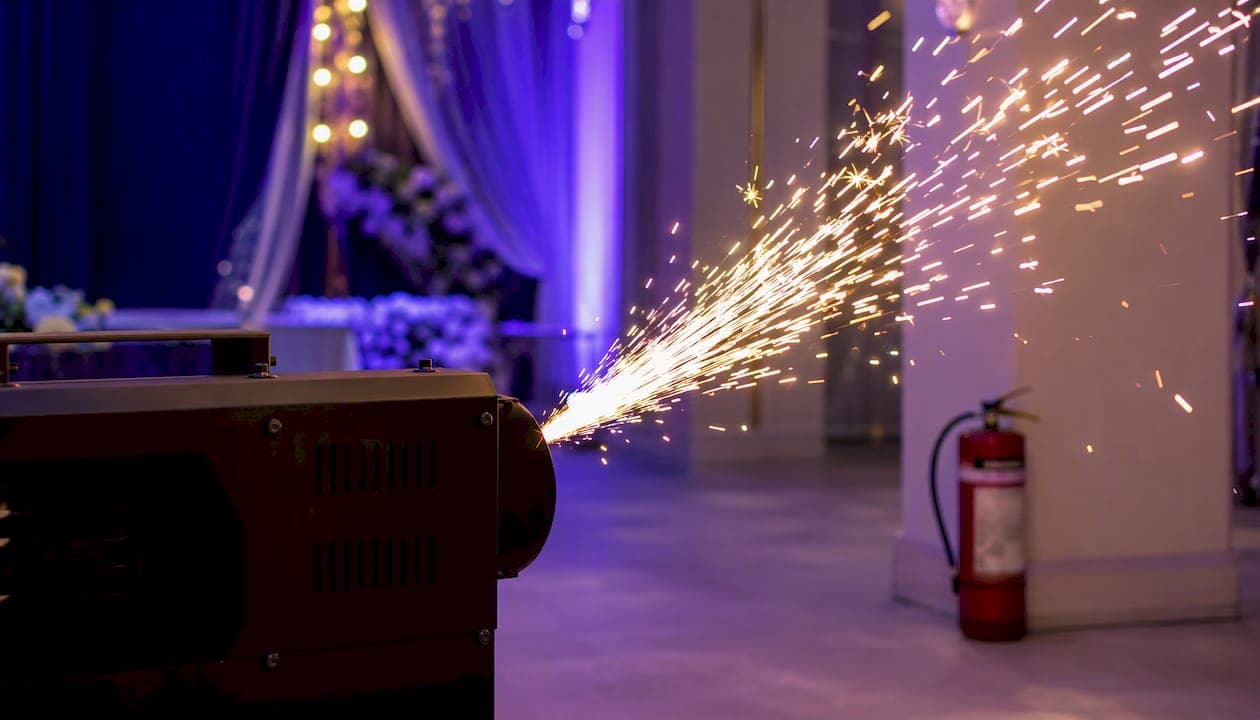
Cold spark machines can be used safely at US events, but "safe" depends entirely on paperwork and planning, not on the marketing claim that the sparks are cold. Under NFPA 1126, these machines are classified as Pyrotechnic Effect Simulation Equipment, which means most jurisdictions treat them like fireworks: permits required, licensed operator required, insurance required.
The direct answer is a conditional yes. A cold spark fountain is appropriate for many indoor and outdoor events, but only after you've confirmed a specific set of items with your vendor and your local fire authority. Before you sign off on any spark effect, verify:
- NFPA 1126 classification is acknowledged by the vendor and matches your local fire code
- A pyrotechnic or special-effects permit has been submitted (many jurisdictions require this at least 10 days out)
- A licensed operator will be present, not just a technician who "knows how to run it"
- Proof of insurance naming the venue as additional insured
- Machine specifications including material composition and manufacturer manual
- Minimum clearance distances from combustibles, guests, and structures (commonly 10 feet)
- A Class D fire extinguisher on-site, rated for combustible metal fires
- A fire watch if your local authority having jurisdiction (AHJ) requires one for the venue type
Copy that list into your vendor RFP or approval email. If a vendor can't check every box, you're not looking at a safety issue you can waive. You're looking at a compliance gap that could shut the effect down the day of the event, or worse.
Key Takeaways
Cold spark machines can be used legally and safely at US events, but only when the permit, licensed operator, insurance, and on-site fire controls are all confirmed before the event, not assumed.
| Point | Details |
|---|---|
| Confirm the permit first | Check with your local fire marshal or AHJ, since rules range from full bans to standard permitting. |
| Verify operator licensing directly | Call the issuing authority; don't accept a vendor's claim of certification at face value. |
| Require proof of insurance | Get a certificate naming your venue as additional insured before signing any contract. |
| Get exact machine specs | Ask for metal composition, rated use (indoor or outdoor), and the manufacturer's manual. |
| Enforce clearance and extinguisher rules | Maintain the common 10-foot clearance baseline and keep a Class D extinguisher on-site. |
| Choose a documented vendor | Fiesta Fusion provides certified operators, permit support, and risk-transfer contract language for Northern Utah events. |
Table of Contents
- What Cold Spark Machines Actually Are and How They Work
- Why Cold Spark Rules Differ from State to State
- Permits, Operator Certification, and Insurance You'll Need to Collect
- The Real Hazards: How Cold Spark Incidents Actually Happen
- What to Require From Vendors Before You Approve the Effect
- Indoor Use, Outdoor Use, and When to Choose a Different Effect
- Handling an Incident: On-Site Response If Something Goes Wrong
- Operator Training Beyond the Basic Certification
- What Venues Get Wrong When Vetting a Spark Vendor
- How Fiesta Fusion Handles Cold Spark Effects Safely
- Sources
- FAQ
What Cold Spark Machines Actually Are and How They Work
A cold spark machine burns metal powder, usually titanium or zirconium, and mechanically feeds or grinds it against a heated element to eject a burst of glowing particles. The sparks look like fireworks because, chemically, they behave like fireworks. That's the entire mechanism behind the effect.
The "cold" in cold spark comes from the fact that the sparks cool and extinguish faster than traditional fireworks, and they don't produce the same lingering embers. But faster cooling isn't the same as harmless. The American Pyrotechnics Association has been blunt about this, warning that the cold marketing label is misleading because the powdered metals used to generate the effect are combustible and the sparks themselves can reach surface temperatures hot enough to ignite fabric, paper decorations, or dry foliage on contact.
Powdered titanium and zirconium can burn at extremely high temperatures, which is why event-safety guidance treats these as combustible metal fires requiring Class D extinguishers, not the standard ABC extinguisher most venues already have mounted near the exits. That distinction alone trips up a lot of first-time buyers.
When you're vetting a machine or a vendor, ask for:
- The exact metal composition used in the fuel canisters
- The rated maximum spark height and burn duration
- Whether the unit is rated for indoor use, outdoor use, or both
- The exhaust or discharge path and any minimum ceiling clearance
Documented incidents involving spark machines, including hopper fires and unsafe fallout near guests, were part of what pushed NFPA to formalize its 2021 classification in the first place. The standard exists because the informal "it's just cold sparks" framing wasn't holding up in the field.
Why Cold Spark Rules Differ from State to State
NFPA 1126 gives jurisdictions a model standard, but it doesn't force uniform enforcement. Every state and municipality decides how, or whether, to adopt it, and that's why the permit process for the same machine can look completely different just two counties apart.
Minnesota treats cold spark fountains as devices that may legally qualify as fireworks in public displays, which pulls them into the state's existing fireworks permitting and certified-operator framework. Loudoun County, Virginia, went further and simply banned cold spark devices inside occupied buildings altogether, citing NFPA 1126 as its basis. Meanwhile, cities like Syracuse and West Milford, New Jersey, allow indoor and outdoor use, but only under specific conditions: sprinklered buildings, licensed operators, minimum clearances, and a Class D extinguisher on hand.
Three jurisdictions, three different outcomes, all working from the same underlying standard. This is the part planners underestimate most. Legal use varies significantly by state and locality, and assuming last year's approval in one city carries over to a new venue is a common, expensive mistake.
Pro Tip: Get your local fire marshal's interpretation in writing, months before the event, not the week of. A verbal "should be fine" from a vendor is not the same as a written approval from the AHJ, and you want that paper trail if anything is questioned later.
Permits, Operator Certification, and Insurance You'll Need to Collect
Once you know your jurisdiction's stance, the next step is gathering documentation. Most permitting authorities want to see the same core set of items, even if the exact form and fee differ by city.
Operator licensing is where a lot of vendors fall short. North Carolina, for example, requires anyone operating this kind of equipment to hold a Proximate Audience license, which involves passing an approved exam and demonstrating experience or equivalent out-of-state certification. That's a meaningfully higher bar than a vendor simply saying they've "used the machine before."
Timelines matter too. Some fire departments require a permit application filed at least 10 days before the event, along with a modest fee, the exact amount depending on the municipality. Miss that window and you're looking at either a denied permit or a rushed, stressful approval process the week of the event.
Here's what a typical documentation and timeline checklist looks like:
| Requirement | What It Involves | Typical Timeline |
|---|---|---|
| Pyrotechnic permit application | Filed with local fire marshal or fire prevention bureau | 10+ days before event |
| Operator certification | Proximate audience or indoor pyrotechnician license | Verified before booking |
| Proof of insurance | Certificate naming venue as additional insured | Submitted with permit |
| Site plan / floor plan | Scaled diagram showing clearances and exits | Submitted with permit |
| Permit fee | Varies by municipality | Paid at application |
| Machine specs and manual | Manufacturer documentation of fuel and ratings | Requested before contract signing |
Who pays the permit fee usually comes down to your contract. Some vendors bundle it into their quote; others expect the venue or host to cover it directly. Settle that before the contract is signed, not after the invoice arrives.
Pro Tip: Ask your vendor for their operator's license number and confirm it directly with the state's licensing board or fire marshal's office. A copy of a card isn't proof it's current.
The Real Hazards: How Cold Spark Incidents Actually Happen
The failure modes for cold spark machines aren't exotic. They're the same predictable hazards that show up whenever combustible material is deployed near people, and they're almost always traceable to a shortcut somewhere in the process.
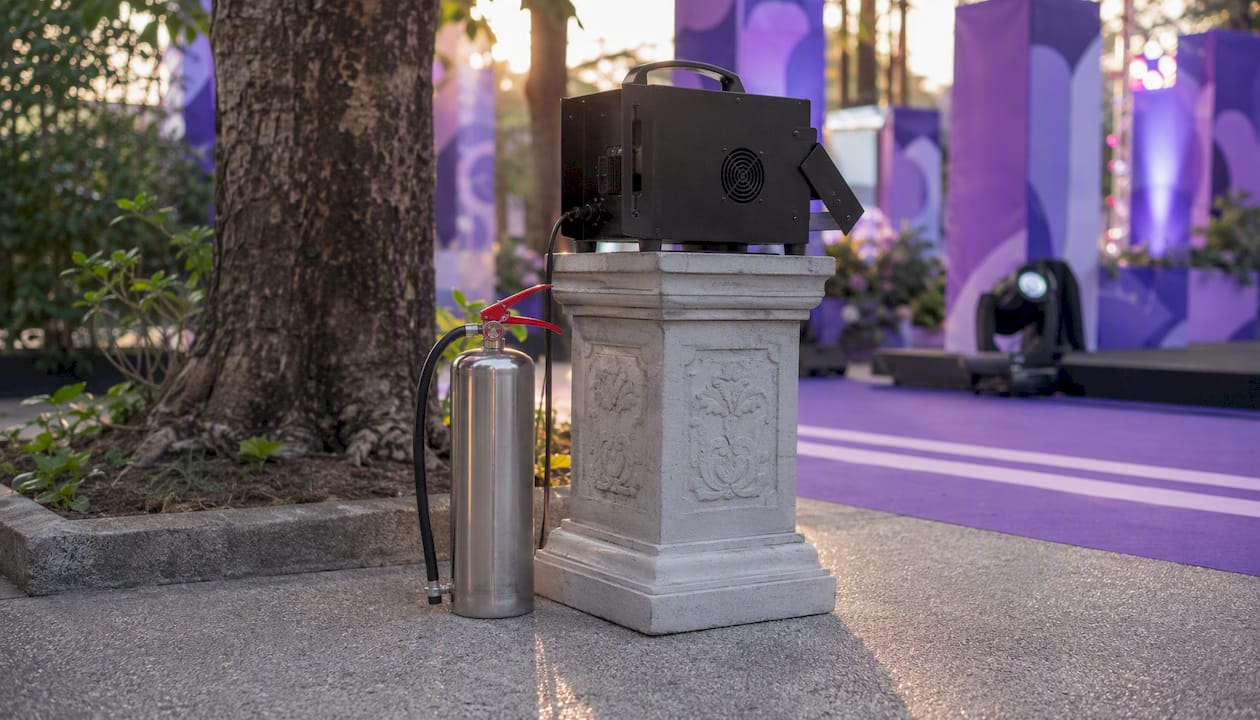
Burns and ignition top the list. A spark that lands on synthetic fabric, a paper backdrop, or a dry floral arrangement can smolder or ignite, especially if clearance distances weren't respected. False fire alarms are also common, particularly indoors, since some smoke and heat detectors read spark output the same way they'd read smoke from an actual fire.
On the equipment side, the failure modes worth planning for include:
- Hopper fires, where the fuel canister ignites uncontrollably inside the machine
- Tip-over, where a knocked or unstable machine discharges sparks in an unintended direction
- Uncontrolled feed, where the mechanical dispensing system malfunctions and produces a longer or more intense burst than programmed
- Improper material mixtures, when a vendor uses uncertified or substandard metal powder
Most of these trace back to human factors rather than pure mechanical failure: an unlicensed operator running the show, a venue that skipped a proper site walkthrough, or clearances that got eyeballed instead of measured. One control that reduces the tip-over and uncontrolled-feed risk specifically is a machine with a manual trip test and automatic shutoff if knocked over, a feature Syracuse's fire prevention bureau specifically calls out in its inspection guidance. If your vendor's machine doesn't have that safeguard, that's a red flag worth asking about directly.
What to Require From Vendors Before You Approve the Effect
Your job as a venue manager or planner isn't to become a pyrotechnics expert. It's to make sure the vendor already is one, and that they can prove it on paper.
Before signing off, request:
- Operator license, current and verifiable with the issuing authority
- Insurance certificate naming your venue as additional insured
- Machine specifications and manufacturer manual
- A scaled site plan showing clearance distances, exits, and audience placement
- Recent maintenance records for the specific unit being used
- A written emergency plan for the effect
On-site, three controls matter more than anything else on the checklist: clearance distance (10 feet is a common baseline cited by both West Milford and Syracuse fire codes), a Class D extinguisher within reach of the operator, and maintained, unobstructed exits. Some jurisdictions will also require a dedicated fire watch, meaning a person whose only job during the effect is monitoring for ignition.
If you're drafting or reviewing a vendor contract, look for language covering operator duties, who's responsible for pulling the permit, indemnification, minimum insurance amounts, and a requirement that equipment is removed from the venue promptly after the event.
A vendor who can't produce a current operator license and a certificate of insurance before the contract is signed isn't ready to run pyrotechnics at your venue, no matter how good their demo reel looks.
Final sign-off typically involves three parties: the venue contact confirming the site plan and clearances, the local fire marshal approving the permit application, and the operator signing an acknowledgment of on-site responsibilities. Skipping any one of those three is how avoidable incidents happen.
Indoor Use, Outdoor Use, and When to Choose a Different Effect
Indoor venues carry the tightest restrictions, and for good reason. Syracuse's guidance requires sprinklered buildings for any indoor cold spark use, and some jurisdictions, like Loudoun County, don't allow the effect inside occupied buildings at all regardless of sprinkler status. Add in the risk of triggering smoke or heat detectors, and indoor approval often takes longer and demands more documentation than an equivalent outdoor setup.
Outdoors, the concerns shift. Wind can carry sparks or combustible dust further than the rated clearance accounts for, and outdoor audiences tend to stand closer to effects than fire codes anticipate, especially at receptions or dance floors set up near the machine.
If your venue prohibits sparks outright, or the permit timeline doesn't fit your event date, there are non-pyrotechnic alternatives worth considering:
- LED confetti launchers, which mimic movement and visual excitement without combustion
- CO2 jets, which create a dramatic burst effect using compressed gas rather than burning metal
- Choreographed lighting sequences timed to music, often paired with uplighting
- Projected or simulated spark visuals, useful for venues with strict fire codes
As a rule of thumb: if your venue is unsprinklered, your event date is under two weeks away, or your local AHJ has a documented ban like Loudoun County's, stop pursuing the permit and move to an alternative. It saves everyone a last-minute scramble.
Handling an Incident: On-Site Response If Something Goes Wrong
Every event using a cold spark effect needs a written incident plan, not just a permit. That plan should name who does what in the first sixty seconds after something goes wrong, because that's the window that determines whether a small flare-up stays small.
The operator's first responsibility is immediate machine shutoff. Most compliant units include a manual cutoff or automatic shutdown if tipped, and the operator should be standing close enough to use it without hesitation. Second, the person assigned to fire watch (required in many jurisdictions for indoor use) needs a direct line of sight to the effect and a Class D extinguisher within arm's reach, not stored in a closet down the hall.
If ignition does occur on nearby material, the extinguishing agent matters as much as the speed of response. A Class D extinguisher is built for combustible metal fires; using a standard water or ABC extinguisher on burning titanium or zirconium powder can make the reaction worse rather than better. This is one of the clearest reasons the extinguisher requirement shows up across nearly every municipal cold spark code, from West Milford to Syracuse.
Your incident plan should also spell out who notifies venue management and, if warranted, local fire services, and who manages guest movement away from the affected area. Practice this with your vendor before the event, not during a live run. A five-minute walkthrough the day of the event, confirming extinguisher location, exit paths, and shutoff procedure, costs you nothing and closes the single biggest gap in most incident plans: nobody actually rehearsed it.
Operator Training Beyond the Basic Certification
A license proves an operator passed an exam. It doesn't prove they've handled your specific venue's layout, your specific machine model, or a crowd the size you're expecting. That gap is where a lot of "certified" vendors still fall short.
Beyond the baseline proximate-audience or indoor pyrotechnician credential, look for operators who can show:
- Manufacturer-specific training on the exact machine model being deployed, not just general pyrotechnic experience
- A documented trip-test and pre-show inspection routine performed before every single use, not just at initial setup
- Familiarity with Class D extinguisher use specifically, since combustible metal fires behave differently than the fires most fire-extinguisher training covers
- Experience working with the AHJ in your specific jurisdiction, since permit expectations shift from one fire marshal's office to another
Some states are moving toward requiring continuing education or periodic recertification for pyrotechnic operators, following the same logic used for other public-safety licenses. Even where that's not yet mandatory, it's a reasonable question to ask a vendor directly: when was their operator last retrained, and on what equipment?
What Venues Get Wrong When Vetting a Spark Vendor
The single most common problem isn't a bad machine. It's a vendor who's confident, well-reviewed, and completely wrong about what their local jurisdiction requires.
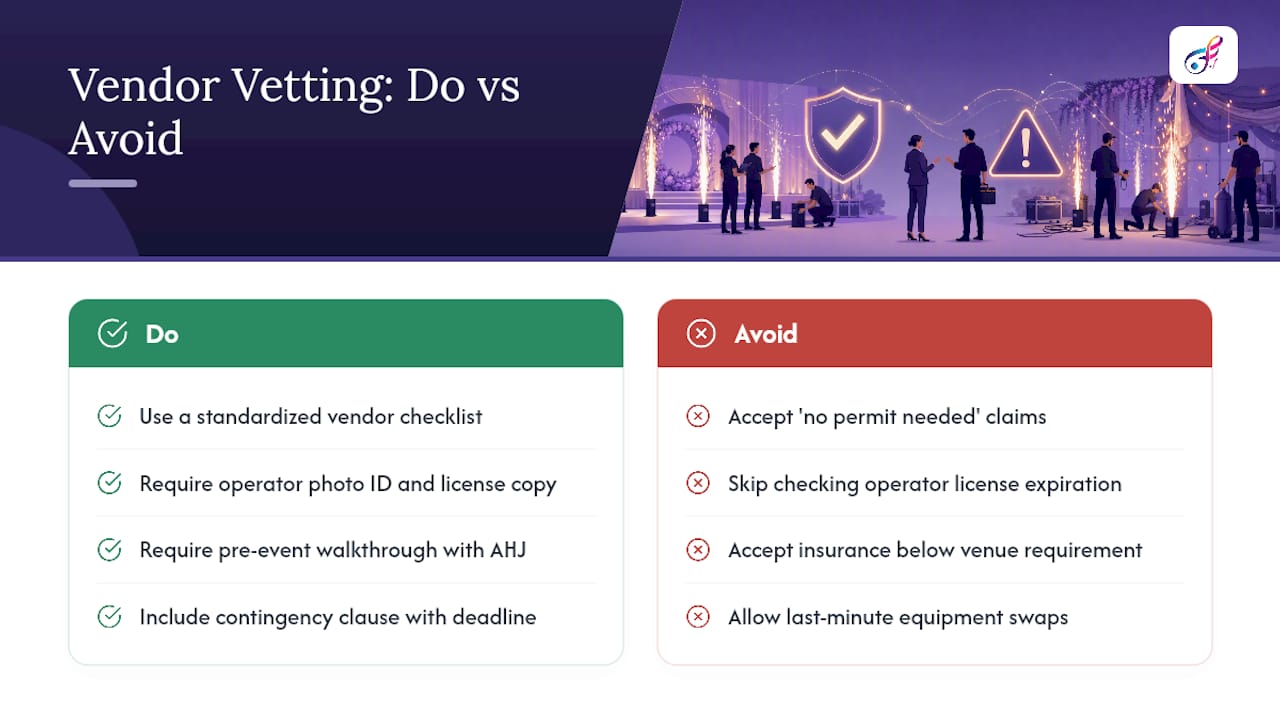
I've seen the same handful of missteps repeat across otherwise well-run events: an expired operator license nobody double-checked, an insurance certificate with limits too low to meet the venue's actual requirement, a machine spec sheet so vague it doesn't even list the metal composition, or a last-minute equipment swap where the unit that shows up isn't the one listed on the permit application.
The "no permit needed" claim deserves particular skepticism. Some vendors genuinely believe this because they've worked in a jurisdiction with looser enforcement, or because they're quoting a rule that applied to a different device category. It's rarely malicious, but it's often wrong, and it's the venue's approval on the line if the fire marshal disagrees on the day of the event. Verify permit requirements directly with your local fire authority rather than taking a vendor's word for it, even a vendor you trust.
A few operational fixes solve most of this. Build a standardized vendor checklist you use for every booking, no exceptions for "we've worked with them before." Require a pre-event walkthrough, with the AHJ present if your jurisdiction allows it, especially for larger indoor venues. And put a contingency clause in your contract specifying what happens if the vendor's equipment or documentation isn't ready by a set deadline before the event.
Pro Tip: Require a photo ID and a physical or digital copy of the operator's current license as part of your booking packet, not just a verbal confirmation over email. It takes five extra minutes and eliminates the single most common documentation gap venues report.
How Fiesta Fusion Handles Cold Spark Effects Safely
If you're weighing whether to pursue a cold spark effect for a wedding, corporate event, or school dance in Northern Utah, the compliance load is real, but it doesn't have to fall entirely on you. Fiesta Fusion handles the documentation and on-site controls that fire marshals actually ask for, so you're not the one chasing down a vendor's license number the week of your event.
That means arriving with a certified operator, current insurance naming your venue as additional insured, machine specifications and manufacturer manuals ready to hand over, and a site plan that maps clearances before anyone asks for one. On-site, that includes pre-event testing of the machine, a Class D extinguisher staged nearby, maintained clearance distances, and a coordinated fire watch when your venue or local code calls for one.
Fiesta Fusion also supports the permit process itself, helping event hosts and venues in Weber County, Davis County, and Salt Lake City understand what their local fire authority requires before the contract is signed, not after. If a cold spark fountain fits your event and your venue's fire code allows it, check availability for certified spark effect packages and get the permit conversation started early enough that it's never a last-minute scramble.
Sources
When you need to cite something directly to a vendor, a fire marshal, or your own risk management team, these sources carry real regulatory weight.
- NFPA 1126 standard development
- Cold Spark Pyrotechnic Devices - Loudoun County Fire and Rescue
- Cold spark fountains - Minnesota Department of Public Safety
- Cold Spark Requirements - West Milford, NJ
- Cold Spark Machines - City of Syracuse Fire Prevention Bureau
This article is general information, not a substitute for advice from a qualified lawyer. Consult a qualified legal professional about your own circumstances before acting on anything here.
FAQ
How safe are cold spark machines?
They're reasonably safe when operated by a licensed professional with proper clearances, a Class D extinguisher on hand, and a permit from the local fire authority. Without those controls, the same equipment poses real burn and ignition risks.
Are cold spark machines legal?
Legality depends on your state and municipality. NFPA 1126 classifies them as pyrotechnic equipment, and while many jurisdictions permit their use with proper licensing, some, like Loudoun County, ban indoor use outright.
What are the common problems with cold spark machines?
The most frequent issues are unlicensed operators, insufficient clearance distances, hopper fires, machine tip-over, and false fire alarms triggered by heat or smoke detectors indoors.
Are cold sparks safe indoors?
Indoor use is more restricted than outdoor use and often requires a sprinklered building, tighter clearances, and sometimes a dedicated fire watch. Some jurisdictions prohibit indoor use of cold spark devices entirely regardless of these safeguards.
Does hiring a vendor like Fiesta Fusion simplify compliance?
Yes. A vendor that arrives with a current operator license, insurance documentation, machine specs, and permit support removes most of the compliance burden from the venue or event host.